Plebian as Johnson was, he knew the ways of Washington. He had been in the House for 10 years and the Senate for almost 5 years, briefly chairman of the committee on the District of Columbia. He knew the art of more or less affably agreeing with everyone and then in due time succumbing to the call of High Principle and doing what he wanted. Senators who lingered around the city waiting for the war to end sounded
Johnson out on Reconstruction and went away convinced Johnson saw
matters their way.
Johnson sat in the grandstand outside the White House reviewing the Army of the Potomac on May 23, 1865, and the Army of the West on the 24th. The taller and grubbier soldiers from the West won the laurels for looking like they did indeed beat the damn Rebel army that had been touted as having the better soldiers since April 1861. Ben Perley Poore the Massachusetts newspaperman who had
become a
Washington fixture marveled at the South the Army of the West brought with them.
At the end of each corps came "mules, asses, horses, colts, cows, sheep,
goats, pigs, raccoons, chickens and dogs led by negroes blacker than
Erebus."
With the war over, Johnson
began readmitting southern states once citizens swore
loyalty to the Union. There was no one in town to object. Congress would not be in session until December. Good thing for the Johnsons. Mrs. Lincoln stripped everything she could out of the White House. (She went way over budget to buy it so she thought it was hers.) The
Commissioner B.B. French had to buy table
settings, and other amenities. But the First Family didn't need to entertain until congressmen came back. Johnson's wife was an invalid but one of their daughters, Mrs. Martha Johnson Paterson, had spent time with the Polks in the White House during vacations from her schooling at the Georgetown Visitation Academy. While not as regal as Mrs. Lincoln, she pleased and without any odor of corrupting opulence.
When congress returned it thwarted Johnson by refusing to seat representatives from Rebel states unless they passed constitutions guaranteeing the freed slaves the right to vote. At the same time they pushed legislation to give black men in Washington the vote. Johnson called the clique controlling congress rebels. After lending support to a rally to get going on building the Washington Monument, Johnson spoke at another rally and more or less wished Sumner and Rep. Thad Stevens hung.
The city and its white citizens became a political prop. Johnson understood how the Radicals meant to use congress's control of the city:
He knew the city well enough to know that most whites opposed black equality. An unofficial referendum in December 1865 proved that the white voters were almost unanimously against blacks getting the vote and/or Congress making that decision without their consent. That slowed Congress for almost a year.
Once a slave owner, Johnson didn't shy from blacks. Local blacks were
not allowed into the White House during Lincoln's last New Year's
reception, save for Frederick Douglass. They could shake hands with
Johnson during the last 15 minutes of his reception. Johnson twice
vetoed bills continuing the Freedmen's Bureau, which Congress overrode
but he did sign the charter for Howard University in March 1867. That
was almost two miles from the White House. But Johnson didn't object
when the headquarters of the Freedmen's Bank moved from New York to a
handsome building on Pennsylvania Avenue.
Johnson did not mistake any advancement by local blacks as a strike against him. He didn't hide in the White House and knew local whites loved him. He spoke at the opening of the city fair, paraded with the masons to the
lay the cornerstone of a new lodge, and he watched the
Washington Nationals lose a ballgame 40 to 16 in the new field at the end of 14th
Street. (The railroad cars from city were packed coming and going.) On
December 3, 1866, in his annual message, he urged Congress to let the
District send a delegate to Congress just as the territories did.
He also tried a charm offensive on the nation with a swing through the Midwest. He had kept the man Lincoln appointed to talk up colonization and heard from him that states facing black demands for the vote were more interested in sending them elsewhere. But despite the racist ranting Democrats lost seats in congress. On
December 14th congress passed a law letting black males in the District
vote. Johnson vetoed the law on January 5, 1867. Congress failed to remove Johnson through the impeachment process but congress promptly overrode his vetoes.
Young Samuel Clemens capped his Nevada adventures by coming to Washington as Senator William Stewart's secretary. As Mark Twain he
would soon lampoon Washington lobbyist and politicians in his first
novel The Gilded Age. In the book Col. Sellers coaxes congress to buy
far off lands, for the advancement of the Negro. H. D. Cooke, bank president and lobbyist for his brother Jay, would never
be mistaken for a Col. Sellers, much too generous. And Sellers' faked
the good cause. Cooke was a true believer.
The Freedmen's Bank had branches throughout the South and with evangelical fervor taught
freed slaves the virtues of saving. Its original charter required it to
invest deposits in government securities and distribute the interest on
same to depositors. But H. D. Cooke was on the bank's board and
persuaded both his colleagues and congress to let the bank invest in real estate and local
stocks like the mining company along Seneca Creek about 20 miles up the Chesapeake and Ohio Canal. Twenty years ago brownstone for the Smithsonian came from there. The new company was prepared to supply stone for the coming building boom in Washington, including brownstone for the facade of the bank, and planned to employ 300 "colored workers."
Twain's burlesque was a hit, but in reality most lobbyists who
came to the city were shrewd realists. The King of the Lobby, Sam Ward, known to be intimate with Baring Brothers Bank in London where the real money was, had a house near Wall Street and a house on E Street near the White House. Treasury secretary Hugh McCullough covered his expenses for delicacies served from his own kitchen and at Welckers restaurant on condition that Uncle Sam persuade rube congressmen to vote for retiring greenbacks. (Charles Dickens made Welckers his headquarters and left a signed testimony that he kept the best restaurant in the world.)
Despite being related to Julia Ward Howe, Sam Ward did nothing for the Negro. He was in Washington to open congressmen's eyes to the real world of money. The mad men in and of the city, government clerks who moonlighted as claims agents, local contractors, and H. D. Cooke, tried to open the eyes of congressmen or anybody else with money to the city itself and indeed, in a way, the cause was the Negro and much beyond merely promoting the Freedmen's bank.
The city itself despite the oversized public buildings had been long enslaved as much as it had been enthralled by the national adventure. Now it was time for the city to become a city. Freedom and equal rights for the black men in the city were an imposition only for the sorry racists. Every white man on the ball could see that with black voters and black workers unchained, the city could finally break its chains, stop being a federal plantation and be free, a spanking new white city like all the rest.
Even with the vote, blacks could not rule. White voters outnumbered blacks 17,757 to 10,772. In 1871 when the District was
divided into 22 districts, only four had a black majority. Two were north K Street NW; the other two southwest along the canal and the far northeast. But 7000 new voters almost all loyal to the Republican Party changed local politic. The last time the city faced a close election, in 1857, Know-Nothing Plug Uglies from Baltimore came down on the B & O to intimidate the pro-Democratic Party Irish vote, a riot ensued, 14 died, and the Democrat won the election.
A strange twist to the 1868 election was the stationing of soldiers in the city which many residents thought was for no apparent reason. When the Radical Republican candidate Sayles Bowen won 9170 votes to 9087. The soldiers petitioned congress bitterly complaining that they were denied a ballot even though they had been stationed in the city longer than many black voters had lived there. Both parties declared themselves winner but Bowen took possession of the mayor's office and, having served as police chief under Lincoln, knew the current chief.
Sayles Bowen had come to Washington from rural New York and wound up working in the Polk administration at the Treasury. Then he got the abolition fervor which got him fired by the Democratic administration. He became wealthy helping people with claims against the government. Bowen was somewhat of an odd duck, irritating and contentious yet idealistic and free with his money for the cause of black liberation.
But he didn't run on that. He grabbed onto a larger cause, the very survival of the city as the nation's capital. Despite finally finishing the Capitol extension to the tune of just
over $10 million, the discombobulation of the city made St. Louis bold
enough to suggest that it, the Gateway to the West with almost three times as many people and truly an industrial and transportation hub as George Washington once dreamed would be on the Potomac, should be the
Nation's Capital.
Washington politicians took advantage
of that boasting. In his campaign for mayor Sayles Bowen resolved that
But Bowen got distracted. His idealism got in his way. Swept to victory by the black vote, he pushed the envelope of the Washington as a paradise for race relations and advocated that the District's schools be integrated.
That was jumping the gun for many blacks. Sumner got a law passed so that blacks could be appointed to city offices. Despite the law there was no way a black would be made head of the city's school system, but William Syphax became the head of the trustees for the city's colored schools. The Syphaxes had been freed by the Custis family not long after Martha Washington died.
Apart from hired staff for white and colored schools, 30 to 40 men oversaw schools after their day jobs. Since 1851 Syphax was a copyist at the Interior department.
Four years of war did not impress the virtues of a chain of command on Washington. Congress threw money around at the end of sessions in mysterious but provident ways. So none were more surprised at the $20,000 spent to build the Thaddeus Stephens School than the trustees of colored schools.
West of the White House on marginal ground at 20th Street, the school was evidently sited to serve the freedmen crowded in the low ground of Foggy Bottom. Students found their classrooms were upstairs and they had to climb outside stairs to get to them. Teachers didn't know what to make of the large hall on the main floor. The trustees began planning another colored school on M Street closer to the Capitol and long time residents. Local alderman Alexander Shepherd saw virtues in low land west of the White House and snapped some up cheap.
For white children the city built Franklin School at 13th and K Streets NW for a quarter million dollars designed by German emigrant Adolph Cluss who came to the city after the failed 1848 revolution in Germany. He had been a member of Marx's and Engel's Communist League, started in Washington as a draftsman at the Navy Yard and Treasury and then became the city's leading architect.
William Prosser, a Pennsylvania born Republican congressman from Tennessee (who
eventually died in Washington State,) cast aspersions
over the whole school system. He had been a school teacher and was
appalled at the money spent on the Franklin School when a third of
school aged children had no schools to go to and most schools were
"in
small, dingy, and unhealthy rooms, in unwholesome localities, in the
stable of a ex-President, in the loft of a livery stable, or in rooms
equally unhealthy or deleterious...."
Prosser, who only
served one term, didn't understand Washington. It exists for the
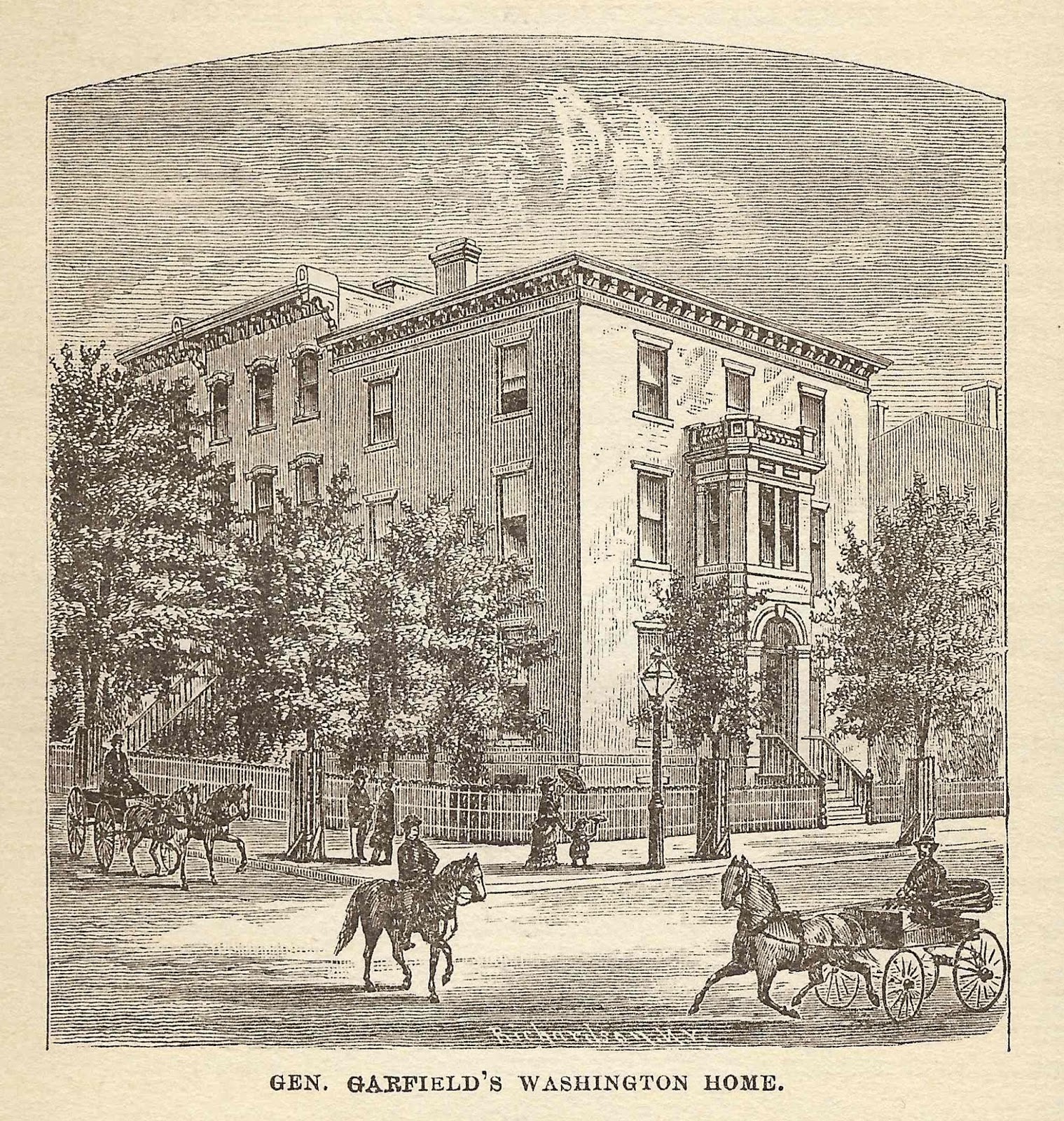
convenience of its rulers, congressmen, and for the glory of the nation. Franklin School quickly became a desirable neighbor for the up and coming. Congressman James A. Garfield lived in a house on the same square.
Mayor Bowen hoped the lack of schools in less desirable neighborhoods might justify one school for both races. He got a report that "an entire square laid out in small
building lots has been disposed of mainly to employees in the Government
Printing House who have already commenced the erection of dwellings for
their own occupation." The square was not far from Freedmen's Bureau tenements. Petitions came from the
area, signed almost by an equal number of white and black parents,
asking for a integrated school. Upon investigation Mayor Bowen's
assistant found a number of whites in the area dead set against.
So children in the outskirts had make-shift schools. Just as after other wars, congress was slow to cut taxes and
tariffs. Congress had money to spend, but it didn't need a model school
system. It needed a model school like Franklin with an auditorium that could seat a
1000. With the rise of Prussia, Germans rivaled British dukes and French
counts in popularity and the new German style building became a tourist
stop.
What defeated the idea of moving to St. Louis was that people started flocking to the city that won the war, the martyred Lincoln's city. Newspapermen
churned out guide books and thick tomes historical and topical. A
principal attraction was Ford's Theater where Lincoln was shot, but in a
preemptive strike to prevent bad taste, the government bought the
building and put the Army Medical Museum upstairs in the theater. The
government also tore down the portion of the Washington Arsenal on
Buzzard's Point where the assassination conspirators were hung.
July 7, 1865, the conspirators hung; September 1867 Stanton orders most of the Arsenal torn down
No one made a tourist site of the Old Capitol Prison across the street from Capitol Square where the spy Rose Greenhow had sulked and Wirz the Rebel warden of Andersonville Prison was hung. The government sold it to the Senate sergeant-at-arms for $18,000. The new buyer tore down the prison yard and gutted the interior aiming to turn it into townhouses.
Most
guidebooks catalogued interiors of the public buildings especially the Capitol. Bermudi's the Apotheosis of Washington in the eye of the Dome needed explaining.
Washington in the Eye of the Dome
But the artistic talk of the town
was the congressional commission given to Vinnie Ream, an 18 year old artist from Wisconsin, to do a full size sculpture of Lincoln for the Capitol. She had left her job in the GPO and
apprenticed with Robert Mills. Lincoln sat for her many mornings as she
essayed a bust of him. She was easy to look at. Public opinion could
not decide if other talents developed while helping lobbyist won her the
commission or she was a genius. She moved to Rome where most American
artists worked out their destiny away from the Philistines. She unveiled her statue in the Capitol (Washington's not Rome's) in 1871 (The Italian
Bermudi became an American citizen.)
Vinnie Ream
Not for nothing did guide books spend chapters describing the paintings and sculptures of the Capitol. The Botanical garden at the foot of Capitol Hill added nature to a tour. But in an era when promenading from point A to point B was in fashion, Washington was a gallery not a garden. The new Agriculture Bureau with its garden added the possibility of another diversion but it was across the canal on the other side of the Mall beyond the Smithsonian, a dusty or muddy mile, depending on the weather, from the Capitol.
The Agriculture Bureau
The more exciting diversion after seeing the Capitol was to walk down to the Navy Yard to watch "the big trip hammer forging sheet anchors" and go on board one of the monitors, which a small iron ship with a turret was called.
A monitor at the Navy Yard
Given L'Enfant's spacious design there was and is always a touristic solution to the city's problems. Congress took the a step in that direction by firing old B.B. French. He wrote a poem lauding Andy Johnson and had no particular talent apart from being a Freemason. The men of vision Congress appointed to address the problems of the public grounds and buildings were army engineers. An obvious improvement was to put statues of Civil War heroes both in the city's public squares and circles formed by merging avenues.
The topographical staff at the War Department mapped an area around Rock Creek for an
urban park to rival those in New York and world capitals and they found a more
suitable place for a Presidential summer retreat, perhaps a permanent home. Soon there was talk that Grant didn't want to lived in the White House. The topographers advised that W.W. Corcoran's
Harewood Park estate, in the hills west of the Soldiers Home, was just
the place for the President.
Just as army is prone to
fight the old war when it plans the next war, the topographers couldn't
see the scramble for housing engulfing the retreats of the city's
antebellum rich. Politicians had a earthier approach to improving the
city. Sen. John Sherman suggested that the expanse of K Street in front
of his house between 13th and 14th NW, broader than
some avenues, be broken up with parking
"to reclaim for trees and
verdure about one half the space now in dusty barren badly made streets
and avenues." The city
council, board of aldermen and mayor passed a resolution to do that bit
of improvement just the way Sherman outlined.
Sherman house after improvements on K Street
The city government had all the legal authority needed to make improvement, assess homeowners for them and authority to borrow money. But one man's improvement was another man's nightmare. John Carroll Brent, a name that rolled with old time religion and old
city pomposity, demanded that Delaware Avenue south of the Capitol where he lived not be
paved. The city's new local political establishment which numbered some
30 elected officials spent most of its meetings sorting out where to put
sewers, curbs, footpaths, pavement and constant leveling. A dispute
over a $1000 contract to level a few blocks of four neighboring streets
tied up the mayor and a city court for two months.
Ever the Radical mayor Bowen tried to make a cause out of improvements by seeing that laboring jobs were divvied out in all the city's ward, especially mindful of the needs of freedmen. But at first they only paid laborers just as the Army Quartermaster did, $20 paid out
every 30 days, except that when pay day arrived there was usually not
enough money in the city's till. The scavengers the city hired insisted
on being paid in advance, and the laborers' wage rose to $1.50 a day.
These "improvements" did get a rise out of President Johnson. He asked an aide "if all the white men had been
discharged." The Freedmen's Bureau laid water pipes from the Capitol to
the tenements built for freedmen down East Capitol to 14th Street.
Democrats mocked the freedmen being offered the right to vote as "pipe
layers."
Some black laborers had class consciousness, a notion Karl Marx was making popular in Europe, and formed Workingmen's Associations. Their parade in November 1865 briefly jammed the Avenue, but their one strike for $2 for an 8 hour day fizzled as laborers by twos and threes went back to work for $1.50. The trend of American history has been to make Marx as irrelevant as possible but the powers in Washington understood the import of his message. The Board of Aldermen and Common Council prefaced a joint resolution,
"That whereas the laboring man
is the bone and sinew of the land and should be recognized as our
general benefactor for many reasons therefore be it..." May have helped. As one black preacher/politician put it, men in his district "got into the habit of working."
For all his high purpose Bowen ran up the bond indebtedness to $800,000 with little to show for it. His successor Mayor Emery, who had made his career doing stone work for several of the public buildings, issued $900,000 in bonds with little to show for it.
With its legislature controlled by Republicans including some blacks, pro-Democratic party newspapers attacking blacks and carpetbag Republicans in Southern legislature cast their net of ridicule over Washington's local government. One legislator warned his colleagues:
"The newspapers of this city and the newspapers of other cities
represent this hall as frequently presenting scenes of vulgarity and
violence and as constantly resounding with bitter denunciations and
gross and degrading epithets and the flippant commentary is very general
that the Republican majority in Washington has so degraded its
legislation that the necessity is apparent of abolishing the City
Government and placing the whole District in charge of a Commission
appointed by the National Government."
Local men with vision were not fooled by Sumner's cause of making the city a model for the South. Why was democracy necessary for development? Alexander Shepherd got out of legislature and had his political friends prevail on President Grant to appoint him to the Levy Court of Washington county. Born in 1835 the Washington native and plumbing contractor won election to the City Council in 1863 but was impatient to get things done. The Levy Court directed improvements in the District north of Boundary Street, which became Florida Avenue when the boundary with Washington City no longer made a difference. Shepherd bought a farm north of the city that he called "Bleak House" perhaps because Charles Dickens visited the city again about the same time.
It is fair to say that Shepherd undermined Bowen and Emery and local democracy. He pushed a bill in Congress to replace the elected mayor with a governor and aldermen appointed by the president. Emery acquiesced because he thought he would be appointed the governor. Voters would only elect a lower House of Delegates. Other than pay for grandiose buildings, congress had long been bored if not annoyed by District affairs. On "District Day" laws were past that were hardly digested. Even Garfield, sometime chair of the District Committee, didn't notice that Shepherd's bill put street and sewer improvements completely in charge of a five man Board of Public Works also appointed by the President.
Those Washingtonians who knew how to influence congressmen favored the changes. The bill became the Organic Act of 1871 and Washington would not elect a mayor for another 95 years. Electing delegates was enough meat for any with a tender regard for hearing the voice of the District's people and the 8 wards became 22 districts with blacks having a majority only in four of them. Not that marginalizing blacks was the sole intent of the re-organization. Since the mayoral election of 1857 local voting had been too tumultuous. Congress did not like being upstaged. Plus the voice of the people was pretty well united: the city was a mess. The problem was getting things done so let the General appoint the Governor.
Grant had a fair measure of the city, and, at first, he was its god. There was a sense that after the war the nation had to rise to
greatness and a
sense that the man who won the war was the man to do just that. Even
Henry of the cynical family of Adams thought that. After the war, friends put Grant in
the Douglas house at New Jersey and I Street. Congress raised him from
Lieutenant General to General of the Army and President Johnson put him in command. Most days, in an unassuming manner that delighted
all, he rode cross town to the War Department.
Grant was the first West Point graduate to become president. Hence, there was an engineer in the White House. He made another West Point engineer, Gen. Orville Babcock, the Commissioner of Public Buildings, and also his private secretary in the White House.
Babcock, with wife and niece, and Grant, with wife and her friend, on vacation
Congress expected the new government to push improvements and it allowed a $4 million bond issue to finance them. Congress asked army engineers to study and suggest broadly what the new city government should do. Not Babcock, though, he went to Santa Domingo to scout out the US government buying the country as a safety valve for freedmen. Obviously a man of vision. The engineers raised three priorities:
"The first
thing taken into consideration was to provide a thorough plan of
sewerage not only for the present but for the future of the city. In the
second place it was to establish a uniform and definite system of
drainage. The third was to improve the city in the way of parking and
beautifying."
With Shepherd, Bowen and Emery expecting to be governor, Grant appointed his sometime riding buddy H. D. Cooke who had so graciously given him shares and subsequent dividends in the brownstone rich Seneca Creek mine. Cooke expected the stock to return a dividend of 30%. Many politicians beat a path to H. D. Cooke's offices on 15th Street to get notes carried over and other favors either at the Washington office of Jay Cooke's investment bank downstairs or the First National Bank of Washington upstairs. H. D. was president of
the latter. More important Cooke treated Washington journalists to an annual Potomac cruise with all they could eat and drink.
Although he was just the man to sell bonds to raise $4 million, H. D. was less a man of action and vision than one who took care of people. Brother Jay, by then the most famous banker in the US thanks to his selling the civil war bonds, advised H. D. to take the job because having "Governor" in front of his name would impress Europeans whom Jay hoped would buy up his Northern Pacific Railroad bonds. H. D. had to stay in Washington until the railroad got all it needed from Congress, then go off to Europe.
Governor Cooke sold the bonds for a great price, but young, manly, and dynamic Alex Shepherd running the Board of Public did all the work.
Every contractor began calling him "Boss" because he approved all contracts. In just 16 months those contractors laid "ninety-three miles of brick and concrete sidewalks, and 115 miles of
concrete, wood, round-block, graveled, cobblestone, Macadam, or Belgium
block streets."
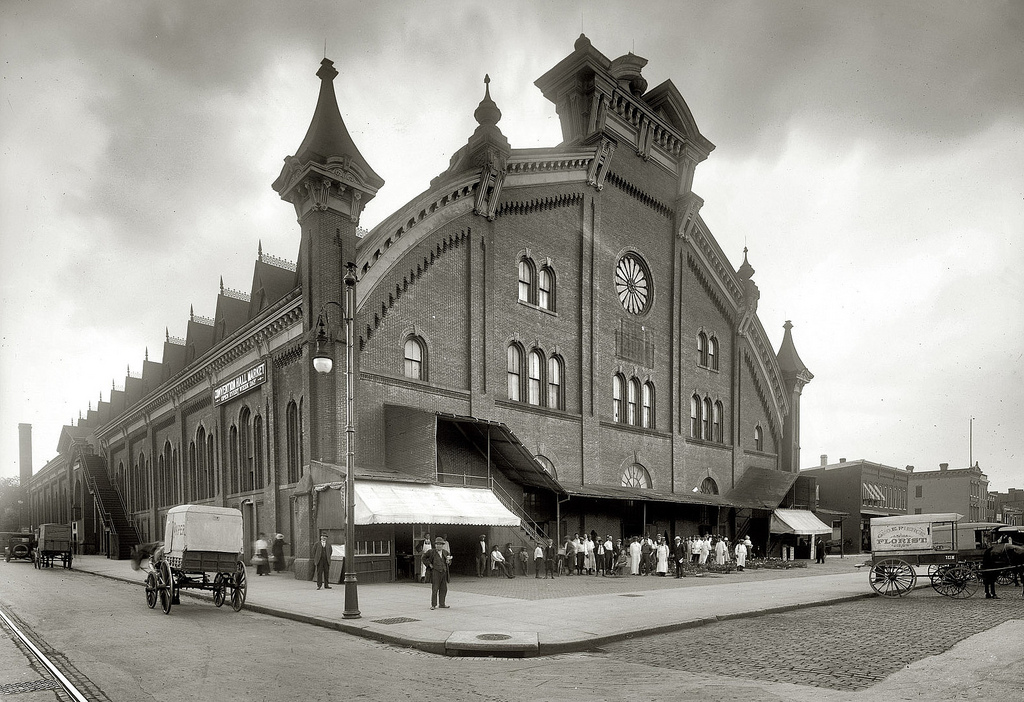
Actually he didn't boss all the work not when a more elegant solution to a particular problem could mutually profit a wide circle of friends. Congress had authorized the mayor to build a new Center Market improving that essential service that had been on 7th Street NW just below Pennsylvania Avenue since 1802 off which the city made up to $14,000. But H.D. Cooke and his usual associates, including Shepherd, came up with a better idea: the Washington Market Company. It would sell stock to raise $1 million in capital to build not just a new market but a $700,000 office building also along Pennsylvania Avenue. In May 20, 1870, Congress chartered the company with the proviso that it recompense the current owners and occupants of the market for the value of their stalls and effects. No problem, in December 1870 the old market completely burned down making way for Adolph Cluss's elegant new market which he claimed was the largest in the world. The company's prospectus that so attracted congress detailed the building materials Cluss would use: "encaustic English tile,... best narrow North Carolina pine,...French plate glass of the finest quality." All say "aye!" it won't cost the government a penny. (Kluss built the market, the company only raised $150,000, gave up on the office building, gave back half the land it leased for 99 years and wound up paying an annual rent of $7500 for what land it kept. Who would have guessed that land along Pennsylvania Avenue would eventually be more valuable than that in the next 99 years?)

Center Market
Center Market took 7 years to build. Gilded Age is probably not the label to apply to
Washington at this time. Perhaps "over built".
Shepherd did all his work in far less than 7 years. He did away with time consuming bidding. He knew what things should cost. He soon had a team of engineers, not from the army, to show contractors where to level and pave. He soon had over 500 clerks to keep track of the money and the work.
He understood the town he grew up in and knew where congressmen came from. He gave contracts to pavers from Brooklyn and Chicago. But in the main, he encouraged local men to get most of the business. Michael Shiner had been one of the slave's hired to work at the Navy
Yard. (He left a diary of those days, from 1820 to 1865,) After he got
his freedom he remained at the Navy Yard, a painter for $1.50 a day. He
knew Alex Shepherd's father and knew Alex well. The Boss encouraged him
to take one of the contracts for leveling a portion of 11th Street. In one neighborhood, black laborers organized to be the contractor for their own leveling work and split $450 in profit.
Shepherd also had a larger sense of what was happening. He bought some of the cheapest lots, even bought a "skating rink" along and around F Street which divided the low grounds west of the White House. He then leveled F Street so that his houses were more or less level with the street while earlier builders who had wisely built on high ground found their houses separated from the street by a four foot cliff. When a congressional committee looked askance, Shepherd answered: all the property west of the White House, once "perfectly dead... increased in value 50 per cent I have no doubt about it."
The Organic Act loosed the new government on the whole District of Columbia including standoffish Georgetown. Shepherd minted $190,000 worth of contracts to improve the 7th Street road past Bleak House and all the way to Silver Spring, Maryland. Old Francis P. Blair who discovered the mica laced waters just north of the District Line and built his mansion there applauded the bold plans: they "
fill up the outline which nature seems to have destined
for the site of the capital of our country. The city and its surrounding
district will then become one vast amphitheater mounting by grades from
the Potomac to the hills five miles beyond its northern boundary and
500 feet above the tides. The first terrace arises from the circle of
Boundary street making that beautiful coronet of wooded heights that
crowns the brow and looks down upon the city and the expanse of its
river as far as Mount Vernon and Fort Washington. The next grade brings
us to the circuit of forts that protected the city during the late war.... The third elevation is
that which makes the dividing line between the District of Columbia and
Montgomery County Maryland. Seventh street road ... meets all the country roads that
converge at Silver Spring.... all macadamized are brought on the
District line at this spot.... It is to be the greatest city in the
world and the wards of the Government are doing the work, the negroes. We
are paying them but I think the Congress will pay us back some day."
Such was the calm view from miles away. In the city leveling roads and digging sewers tried everyone's patience. Then on a warm night
in September 1872 Shepherd perpetrated his most remembered outrage. While he
wined and dined the only men who could stop work, the city's judges, in
far away Bleak House, an orderly gang of workers demolished the Northern
Liberty Market. Young Millard Fillmore Bates was chasing the fleeing
rats with his terrier when a shed roof tumbled down and killed him. A
market dealer died when a sign his clerks were taking down fell on him.
The
Board had letters complaining about the dilapidated condition of the
market dating back a decade, but owners of stalls valued them at a
$1,000 a shed. No one forgave Shepherd but hundreds had the prestige and
talking point of a claim against the government. The Board bought a
neighboring square and a new Northern Liberty Market slowly grew.
One thousand residents petitioned congress to have all the "improvements" stopped and petitioners professed to have evidence of corruption and fraud. His attackers couldn't resist attacking everything Shepherd did. Despite years of congress demanding a solution to the problem,
petitioners and Democrat allies railed against Shepherd for covering
the canal and turning it and Tiber Creek into an underground sewer. Democrats,
that is, except old Frank Blair who told the committee that Andy
Jackson himself thought a canal in the the middle of a city on tide
water was foolish.
Tiber Creek sewer at 17th Street in its prime and uncovered
Republicans controlled both houses but it allowed minority members a
thorough months long airing of the petitioners' grievances. Democrats
couldn't resist turning the tables on Republicans who had long boasted
of their fights against Boss Tweed and the Democrats' Tammany Hall
political machine in New York City.
After Shepherd denied he had ever
met Tweed, the Democrats on the committee produced a letter from Tweed
saying he had met a committee from Washington that included Shepherd.
And wasn't it strange that the paving contracts in Washington used the
exact same form as Tweed did?
Republicans had also long accused
Democrats in cities of buying votes by hiring workers. Governor Cooke and "Boss" Shepherd oversaw one election for delegates
and a referendum endorsing the $4 million bond issue. One petitioner
produced evidence that 14,000 men worked for the city on election day
and the referendum got 13,000 votes. Then after the election most
laborers were fired. R.D. Ruffin, a Howard student hired as a time
keeper, testified that he was fired for organizing voters against
Shepherd's candidate. Shepherd always had answers. The early on-set of
winter required the road work stop. In the election which Shepherd
reputedly fixed, the two candidates were both Republicans. The
difference was their race. The "colored" man won. Shepherd had backed
the white man.
Shepherd touched all the chords of righteousness when he defended
himself before the committee:
"Who does not know that this city, whether
justly or unjustly does not
change the fact, has the reputation of being a century behind others of a
like population in all that relates to public improvements and
progress,
when as the capital of the Republic the resort of people of all nations
we should be foremost in these things. To effect this object money is
required.... Besides all
this we have thousands of mechanics and laborers unemployed many of
whose families are suffering for bread. We should strive to give these
employment as far as possible to make them and their families
comfortable and contented, by doing which much that tends to vice and
crime will be destroyed and the morals of the people improved."
But the myth of the all powerful Boss
Shepherd was born and the Boss didn't seem to mind. He bragged to the
committee that he was worth $300,000 and had every intention to continue
buying and building houses throughout the district. The architect Cluss
soon joined him on the Board and in a few years Shepherd's row of elegant town houses
graced K Street not far from Senator (soon to be Treasury secretary)
Sherman's house.
Shepherd's Row
Few historians can resist the florid tones with which
the press framed Shepherd as another Boss Tweed. Shepherd bossed contractors and controlled officers in the city bureaucracy, but unlike Tweed did not take kickbacks and rule through the ballot box. Shepherd did not need loyal voters the way Tweed did to cement his power. Unlike in New York City, voters in Washington had absolutely no influence on national politics.
Shepherd did not hire "colored men" to control their vote. Most blacks were loyal Republicans. Sumner who had done so much to guarantee rights for blacks couldn't
persuade black congressmen to dump Grant who was too corrupt
for Sumner. Blacks all backed Grant for re-election. They knew who really
freed the slaves.
Politics was not Shepherd's problem. He faced a complex engineering puzzle. Comparing Shepherd's improvement to Baron Haussmann's
in Paris in the 1850s is somewhat off the mark. They are
similar in that both men were given extraordinary powers, but Haussmann
destroyed the Medieval city, widening avenues, opening vistas. L'Enfant
had already provided that. Shepherd made streets and avenues narrower
which made paving less expensive and by parking trees made grand dusty
streets residential. Except for the markets, his improvements did not displace people, only inconvenienced them for the supposed greater good.
But what was good in 1872? Even though most other major cities were paved, none were paved consistently. Streets had to accommodate horses with horseshoes dragging carts with narrow iron wheels. "Ironized" wood block pavement was popular because it was quieter than concrete or macadam. Asphalt was still in development, and reserved for special sections of streets where it menaced people on hot summer days. Briefly put, an expert engineer could be found to challenge every contract Shepherd made, and engineers could be found to defend them. In the large map below, the beige streets were paved with wood.
A map showing the different new pavements: wood in beige, red for concrete, blue for stone pavements
But at least this was unlike all the monument building which did precious little to build a comfortable city. The improvements invited an influx of northern money. One reporter estimated that 500 elegant homes were built in 1872. Why did the wealthy want a
seat in Washington? Now that one could better navigate the distances,
the city provided a good show during the winter and the weather was
better than northern snows.
How President Grant related to all this is an interesting question.
Like Lincoln and the war, Grant was and is framed in every scandal that touched his
administration. Even though Republicans controlled both houses, they could not resist
investigating not Grant but the men, especially old friends and
relatives, working for him. Grant faced opposition not only from the
Democratic newspapers but from reform minded Republican newspapers.
But H.D. Cooke's blandishments and generous paid public notices kept local newspaper cool on Shepherd. And the national press was distracted by a bigger scandal.
Getting up a steam of righteousness over congressmen favored with Union
Pacific railroad bonds, much of the Washington press helped engineer the
nomination of newspaper publisher Horace Greeley to run against Grantism in
1872, but he lost to the unflappable man who beat the Rebels.
Grantism was not that bad especially in Washington which was pretty much as close to paradise as Washington ever got, for whites as well as blacks. Money ruled and the "drippings" got down to the lower sort. Trying to trace what happened to an unaccounted $10,000 that an investigating committee thought a shady agent used as a down payment on the Harewood Estate, that worthy replied: "clothiers, dress makers, milliners, hotel men. It is easy enough to spend that amount of money here."
Even Julie Dent Grant, perhaps the plainest of first ladies, with a slightly weird "one eye in the pot the other up the chimney" face, fascinated the wives of other great men. Like many army wives, she was both independent and loyal, and by reputation got her share of the spoils for the benefit of her family. She did not act the queen like Mary Todd Lincoln. She was an American woman. Grant tried to sell the Douglas house to Mayor Bowen, but Julia refused to sign the deed. But once in the White House she made herself at home and proved indefatigable in entertaining the swirl anxious to see her famous but usually silent husband.
Julia Dent Grant
The Grants lack of pretensions and respect for success made Washington society easier: if you had money you were in and regardless of race. They were as comfortable with respectable blacks as they were with whites. The Lincolns liked to be seen socially with Charles Sumner. The Grants hated Sumner and embraced the Senator Roscoe Conkling. The New Yorker best known to history for tightly controlling federal officials in New Yorker, the consummate spoilsman, also had a golden tongue and was exquisitely educated and coifed. After the General, he was Julia Dent Grant's man. Kate Chase Sprague couldn't take his eyes off him either. Her husband was still in Senate, a convenient excuse for her sitting in the Ladies Gallery.
Senator Roscoe Conkling, worth a trip to Washington to hear and see
Looking back from an age saturated with images of beautiful, it is beyond belief that the elite of the 1870s were drawn to Washington by the portraits in the illustrated newspapers of the General and Senator Conkling and his ilk.
Not President Grant, per se, because the gathering of rich began when Johnson was still in office. In 1873 a letter written by real estate agent Hallet Kilbourn found its way
to an investigating committee. It described a "concrete ring" and a
"real estate pool." Governor H. D. Cooke seeded the latter with $25,000.
Local contractors were in the "ring" that tried to monopolize paving in
part by getting and sharing the best machinery for the job in New York. Other than
Cooke, investors from Philadelphia and New York joined the "pool. "
Kilbourn refused to reveal their names. Otherwise he was a friendly
enough witness explaining how he bought a lot from an avowed opponent of
improvements for 30 cents a square foot and sold it to a senator for 90
cents.
Corcoran and Riggs unloaded much of their unimproved land in part to get out of paying the tax assessments for street leveling and paving Their unpaid taxes almost topped $20,000 each. But in Kilbourn's opinion, the old fashion speculators were the losers as land values rose.
The boom in property values was primarily in
the northwest section of the city. Kilbourn did not take credit for
that. For the last 10 years it was evident that "the tide" of the city
headed that way. Property values increased east of the Capitol but in
one instance only from 5 cents and square foot to 25 cents. A Philadelphia developed built "Philadelphia row" on 11th Street SE where a new bridge crossed the Anacostia River near the Navy Yard, but otherwise the tide from the Capitol was decidedly blocked with the canal and Mall to the southwest, printing plant and railroad depot to the northeast.
To the south across from the Carroll mansion near where the Washington administration was stunned in 1791 as L'Enfant tore down the first iteration of the mansion, officials thought the lots across the street where condemned stone was stored would be a good site for the new jail. The Freedmen's Bureau tenements spread out along East Capitol Street.
Kilbourn
explained that outsiders fueled the boom and the nation's
wealthy wanted a seat in Washington north of the White House. Rich senators like John Sherman were the pilot fish. (Senators got rich because they all did legal work and railroads paid senators handsomely.) At the first "the tide" in that direction beyond K Street came for the wrong reason. Senators Edmunds and Bayard built homes on little hills on Massachusetts Avenue just west of 14th Street. They appreciated the gentle hills for affording a healthy place for their family.
Across and just up the avenue, W. W. Corcoran also made his mark for the wrong reason. He followed the tradition set by Washington's first philanthropist Amos Kendell who built a school for the deaf in the first hills northeast of the Capitol. In 1871 Corcoran built Louis House
"for the support and maintenance of a limited
number of gentlewomen, who have been reduced by misfortune" mostly due to
the War. The site Corcoran choose for
the building was the entire city block bounded on the north by Massachusetts
Avenue, between 15th and 16th Streets, NW. It cost $200,000 to build in the popular French Mansard or Second Empire style,
Corcoran's charity Louise Home was named in honor of both his dead wife and daughter
Well, Corcoran's impulse was in the right direction but eventually the relics of senators, admirals, generals and judges would be housed in the luxury apartment buildings going up Connecticut Avenue.
Then to the chagrin of Edmunds and Bayard, the Board leveled the avenue through the hills. Babcock was preparing the circle at 14th and Massachusetts for the statue of Gen. Thomas and Shepherd decided to flatter Corcoran by improving the view of Louise House. (It was said most of the widows were Southerners and so may have blanched at seeing the Yankee general,"The Rock of Chickamauga," on his horse.)
Senators Edmund and Bayard were in Europe when their little bit of paradise was left on the edge of a 20 foot cliff. In Shepherd's city, to maximize property values those who could afford them would live in rows of three or four story townhouses, the rest in tenements. Unless you wanted to live out in "Clerksville," up at the end of the train lines in Mount Pleasant where house were made out of the planks salvaged from the hospital.
Finally L'Enfants
plan began to make sense. In the northwest section of the city
one could be positioned on or near an avenue cutting directly to the
Capitol and also be on an avenue convenient to the White House and
Treasury. That the area north of K Street housed more blacks than whites
made no difference. Every black man could get a laboring job and soon buy into their rightful place in the new city.
Grantism gave blacks every indication that they were wanted. By and large the city that lined up with Johnson's racism accepted
Grant's tolerance. During Grant's administration leading black men dined with white men,
Republicans to be sure. For a Democrat to socialize with a black could
be the kiss of death.
The city government banned discrimination in hotels,
restaurants, even barbershops. Blacks had begun annually celebrating Emancipation Day, April 16. On July 5, 1870, blacks swarmed the Capitol grounds to celebrate the graduations at colored schools. At Grant's 2nd inaugural they freely participated. Douglass's National Era newspaper proclaimed that
"the
genius of liberty was epitomized." "Colored cadets marching side by side
with white cadets, colored marshals, colored militia, colored
Congressmen -- all took part in a ceremony in which only a few short
years ago none but white persons were allowed to participate....no white
person left the inaugural ball.... There seemed to be a general
acquiescence to the new order of things."
To the disgust of the diplomatic corps Grant shook hands with the black president of Haiti at the White House. He balked at receiving 19 year old Prince Arthur from Britain. Grant was far more interested in buying Santa Domingo than settling Civil War claims against Britain.
Meanwhile Sumner finally gave the nation a righteous legal pattern. The Civil Rights Act of 1874 did not confer on all blacks the rights they had in the "Paradise for Negroes" but it was a big start. That said, Washington proved no pattern for the rest of the county. Pitchfork Ben Tillman continued leading a reign of terror against black voters in South Carolina. Federal attorneys might indict but no Southern jury would convict.
But Americans never admit defeat and adjusted to the civil war in an odd way: both sides won. As it dawned on Washington that they had not reformed the South, its statesmen renewed their faith in lighting the world with American freedom. By buying little Santa Domingo Grant thought freedmen could plant freedom in the tropics. After his house in Rochester, NY, burned down Frederick Douglass moved to Washington. After a life of escaping to freedom and fighting for justice, he breathed a new air. At Grant's request he went with a committee to
Santa Domingo to verify its suitability for black American. His new Capitol Hill neighbor Gen.
Babcock shared his dahlias with the Douglasses.
Sumner broke with Grant over the issue, but not the principal of expansion. He insisted that the government demand over a billion dollars in damages from Britain and use that as leverage to get Canada instead. Upon retirement, Secretary of State Seward who survived an assassination attempt and the Johnson administration decided to tour the American West and then the world, though not all the way up to Alaska which he bought from the Russians. He also survived his wife and daughter so he made the tour accompanied by a friend of his daughter's, a budding writer named Olive Risley whom Seward adopted so there would be no scandal. She turned the tour into a best selling book. They began by accompanying a government commission, protected by US troops, that inspected Jay Cooke's Northern Pacific Railroad then built as far as the Dakota country.
In the wilderness Seward and his ward had big ideas, that both Canada and Mexico would join the superior republic thriving between them. Jay Cooke agreed and thought western Canada would simply be taken over by more enterprising Americans moving north and Britain would accept facts on the ground and give the country up. Overseas, in the cities of the older world, Seward and Risley made a measuring stick of the Capitol: "Government House which was built during the administration of the Marquis of Wellesley has dimensions perhaps one fourth less than the Capitol at Washington." In China they got a warm welcome. The US diplomat Seward had sent to China returned to Washington to represent China in negotiations for a treaty between the two countries.
Anson Burlingame presents his credentials as Chinese envoy to President Johnson, kind of an Indian agent for the world's oldest civilization
Such large thinking usually inflates Washington, and justifies every improvement in the Seat of Empire, but not on September 18, 1873. At the dinner marking Governor Cooke's retirement ostensibly for a well earned rest but actually because his brother needed all hands on deck to save the Northern Pacific, the House of Cooke suspended payment. Everything in Washington stopped, even jury trials, and there was a run to Fifteenth Street. Grant was not in the crowd. He took a train north with his Treasury secretary to confer with Wall Street bankers. The failure of Jay Cooke closed the First National Bank of Washington immediately and six months later the Freedmen's Bank.
Not a little politicians' capital was invested in the First National so even its more profound collapse was not pried into, and remember all those parties H.D. Cooke had for newspapermen, that annual Potomac cruise. But congress investigated the failure of the Freedmen's Bank and the press rallied to ridicule blacks. The colored bank tellers did not know
how to add. The head cashier and his assistant, also his son-in-law, were obviously corrupt. They lived in "
a magnificent four story house in G street of
pressed brick and brown stone Seneca trimmings and with all the modern
ornaments. In this palatial residence Daddy fares sumptuously every day
displays the choicest furniture and gives entertainments to the
aristocracy of his own people for whose amusement Boston drums on a
grand piano. Love of truth constrains me to add that these assemblies are
at times somewhat mixed, a number of persons who look to the bank for
favors making a show of bleached faces."
Wilson got a
job in the Treasury Department and he excused himself to depositors by
explaining that he thought, like most everybody else, that the Treasury
backed the Freedmen Bank's deposits. It didn't.
The failure diminished some icons. The trustees made Frederick Douglass president but he failed to save it, and lost $10,000 of his own money trying to do so. (James Wormley, a trustee of the bank, took heed of inside information and withdrew his money just before the bank suspended payment for 60 days, its last effort to save itself. At least Wormley, never a slave but many years a caterer, saved his elegant hotel at 15th and H Streets which had opened in 1871. It was said by one reporter to be "the best place for an ice or a quiet supper.")
Wormley's Hotel
The bank eventually lost $2 million for depositors half of them black. To help ease the pain, the federal government bought the bank building for the home of the newly formed Department of Justice.
A large contractor for the Board of Public Works, a former bureau official, owed the most money to the bank, around $220,000. He used "sewer notes", scrip issued by the Board promising future payment, as collateral for loans. The scandal could be linked to Boss Shepherd.
Because of the Panic of 1873, the District government also failed as much as a government can fail. When congress investigated Shepherd again in early 1874, District employees including teachers had not been paid for five months. The Boss, who Grant appointed governor when Cooke retired, tried to explain:
"Shortly after this the financial crisis came on and money has been worth
more than nine per cent a year to almost everybody and the payment of
taxes has been deferred. There is no penalty for nonpayment. They do not
fall due until July and there has been no way therefore of meeting the
demands of the government.... If all our taxes had been
collected we would have means enough to pay every dollar that the
District owes to schoolteachers, firemen and all its employés and if the
assessments were in such shape that the money on them could be collected
the board of public works would not be short over $1,000,000 or
$1,500,000."
Another long congressional investigation was probably not needed to get the District government changed again. Congress closed down the Board of Public Works. The District delegate to congress pleaded for congress not to increase the
rate of taxation on city residents to pay down the $26 million debt. The
city owed only $10 million of that. The Board of Public Works made the remainder of the
debt and it was created by congress and appointed by the president, not
the voters of Washington.
Congress passed a law reprising the way the immortal George Washington set up the city government: three commissioners and no legislature. Grant thought that was fine. He didn't think of making Shepherd a commissioner. Shepherd's wealth of real estate evidently didn't make enough
to support a wife and 10 kids. He declared bankruptcy in 1876 and
then headed off to prospect in Mexico and recoup his fortune.
Congressional investigators were miffed that they couldn't pin an indictable offense on Shepherd. They were obsessed with "rings" and kickbacks. Why did Shepherd start buying bricks from Baltimore and Philadelphia when Washington, with the help of Alexandria, Virginia, had never had trouble making enough bricks? Shepherd explained that local brick makers conspired to raise the price. He had to buy bricks elsewhere.
Despite all contractors from outside the city being placed under suspicion, outsiders had to clean up the mess. Grant appointed three former congressmen including one from St. Louis, the city that had demonstrated such an interest in becoming the new nation's capital. Evidently not that busy cleaning up the mess in Washington, that St. Louis pol died within the year in Saratoga Springs, NY.
Newspapers consoled themselves for the future lack of local election coverage by accusing and ridiculing black delegates for taking ink stands and feather dusters from the legislative chamber no longer needed. One can conclude that white residents gave up their own vote with hardly a murmur as the price they had to pay to put blacks back in their proper place.
But after just over 70 years of voting in local elections, Washington property owners had never gotten what they wanted: a clear commitment from congress to help finance the creation and maintenance of a credible city. Having blacks vote was no help in that project. In debate northern and western congressmen warned that disenfranchising Washington's blacks was not the example the resurgent racists in the South needed. But Shepherd's energy monetized by an enormous debt raised the ante so high that the long game between the prudent congress and stingy locals had to end.
(However, racists in Washington would forever ridicule the behavior of blacks during their brief period of enfranchisement. William Tindall was Mayor Bowen's secretary and some 45 years later read a paper about him before the Columbia Historial Society. After duly noting Bowen's zeal for civil rights, Tindall mused that "when one reflects upon the dense ignorance, and utter absence of ethical apprehension, of a vast portion of the voting material of the time, it is a wonder that the outcome was not more humiliating to enlightened civic sensibility."
He related what must have been a notorious story in the 1870s that Tom Bowie a "notorious Negro politician of that regime" died after he fell off a boat bringing illegal black voters from Southern Maryland. A friend told Tindall of "an instance of the grotesque notion of partisan fealty which prevailed to a great extent among the newly enfranchised negroes." A black polician suggested he shouldn't have to pay his rent on time because he was a Republican. Tindall personal dig at the race, 45 years later, was his recollection of a black street superintendent, who objected to being called "mister" and not "esquire.")
Losing the vote didn't keep blacks from moving to the city. Their population increased from 43,404 in 1870 to 59,596 in 1880. No one came to the Seat of Empire to vote in local elections. Democracy was beside the point where the leaders of the world's greatest democracy congregated.
Sen. Stewart of Nevada represented fewer people than the number of blacks living in the District of Columbia. No one counted. Stewart invested some of the money he made off silver mines into a stately house to be called "Stewart's Castle" just off what was then known as Pacific circle in honor of the three west coast developers, Hillyer, Sunderland and Stewart. The statue of Admiral Dupont hadn't found its seat yet.
Stewart's Castle
For locals, seeing such a wash of outside money took the sting off having no more voting.
There was another great wind stirring in the country that made losing the vote in Washington opportune if not a victory for good. Civil Service Reform took root in New York City and good government advocates began preaching that public servants should not be corrupted by politics. The dunning of government workers by political parties prior to every election had to stop, as well as doing party work on government time.
Since the fount of all federal appointments was Washington, Civil Service Reform mattered to just
about every stiff able to climb stairs and dodge Greek columns. To raise the level of fear, congress
had the unnerving habit of always combining the word "Reform" with the
word "Retrenchment." There was no better way for Washington bureaucrats to show reforming zeal and avoid politics than to not be tempted to vote.
At first the new city government seemed a prime example of retrenchment. Yes, three commissioners replaced one governor and a board auditors tried to make sense of the city treasurer's books, but congress put Lieutenant Richard Hoxie,
an army engineer, in charge of the Board's contracts, and ordered him to economize. Under the Shepherd there were over 500 clerks
doing the paper work;
under the three commissioners and Hoxie, there were only 84.
The Boss's replacement, army engineer Richard Hoxey
But it soon became apparent that the removal of Shepherd did not retrench, if you will, the spirit of the staff he had hired or the contractors he bossed. While the rest of the country sank into a economic depression after the Panic of 1873 that even a Centennial celebration couldn't perk up, building continued apace in Washington. The logic of Shepherd's improvements, including how powerful senators coming back after the long recess had to snap to them, gave confidence to developers. Hoxie spent an inordinate amount of time getting gravel on top of the holes in rotten wooden paving blocks and patching leaky sewers, but he was full of ideas for more improvements along the lines of . Shepherd's thinking. If people building houses built to codes, didn't opt for a country style house to avoid assessments for gas and sewer hook ups, paving and trees then the city would continue to grow into something special.
Hoxie called for a plan for the rest of the District
"based upon a careful study of the topographical features of the county. Such an assurance of the permanency of improvements in real estate as would be by the ratification by Congress of such a plan would probably secure the investment of much timid capital which the changing grades of the last few years have driven from the District. This is more than probable because it is difficult to imagine a more desirable place of residence than Washington and its vicinity must eventually become. With a mild healthful climate and a picturesque surrounding country the capital of the nation should be with the accumulation of wealth the of refinement and culture."
Here was a man in love, as indeed he was. He married the artist Vinnie Ream, who was busy making more marks in the city. She
lobbied successfully to get the commission for a statue of Adm. Farragut
destined for a square just south of K Street. She beat out 12 male artists. Mrs. Farragut and General Sherman
championed Vinnie. She caught the Admiral perfectly.
Congress forgot to abolish the Board of Health and having the local legislature abolished energized those doctors and lawyers. No one could block their drive to end the tradition of letting cattle, pigs, goats, etc., loose in the city. Such nuisances thought impossible to end came to an end, so the doctor chairing the board somewhat prematurely proclaimed. An energetic homeopathic physician born in Italy, Tullio Verdi, considered nothing beyond inspection and reform especially markets, sewers, privies, fish, abattoirs, etc.
The Board compiled complete health statistics providing valuable epidemiology like names and addresses of the mostly black victims of a smallpox epidemic, and some discussions of morality. Of 104 still-births, only 8 white:
"In this city into which the war has suddenly thrown thirty thousand negroes pauperism has greatly increased and virtue among them at a discount not having been greatly fostered on the old plantations. Hence concubinage with all its dire consequences is quite prevalent. It happens therefore that still births are often the result of doubtful causes requiring the vigilance of the board of health. Many die also in such a state of destitution as to need burial at public expense in which case."
Dr. Tullio Verdi of the Board of Health
Shepherd had let the genie out of the bottle and congress could not put it back in. The old Washington was gone for good.
Meanwhile congress recognized that the federal government had to respond to the growth of the country. Every such response since 1803 had been grandiose and it continued to be. In 1871 construction began on the Executive Office building, what would become the largest office building in the world, just to the
left of the White House, if
you looked at it from the stump that was the Washington Monument..
The first of four sides of the Executive Office Building
The new office building dwarfed the war department nearby and when all four sides of the complex were completed, the artistry of the building designed by James Renwick at 17th and
Pennsylvania would be affronted. The government used the it during the war. When owner W.W. Corcoran got back to Washington, he had the building turned into the art gallery it was designed to be. Renwick left niches on the outer walls for statues. Corcoran had Southern sympathies and commissioned a Confederate war veteran named Moses Ezekiel who was studying art in Rome to make eleven statues of artists. Thomas Crawford was of that number. When the EOB was complete, Raphaels, Da Vinci, Titian, etc, got a depressing eyeful.The cognoscenti like Henry Adams who moved to the neighborhood in 1877 were not please either.
 The Corcoran Gallery of Art in the mid-1880s
It took 17 years to
build the EOB. Congress couldn't cool its obsession with investigating
government building and pestered architect Alfred Mullet to reveal the
machinations of the "Granite Ring."
The creep of grand buildings down the slight 17th Street hill brought future problems in focus. No serious boats could get up to the 17th Street wharf west of the monument grounds. And, as Lt. Hoxie put it, "squatters have usurped the rights of the General Government unopposed and occupy the line." Worse still "a belt of poisonous marshes stretche[d]" almost from Georgetown to Buzzard's Point where the Arsenal was.
This was neither an old or new problem. L'Enfant didn't have to deal with it because the marshes arose well after he made his plan. The Potomac River silted up below Little Falls thanks to land upstream being cleared and cultivated. Ribbons of reality though they are, rivers can tease. Most years spring floods would make the river whole again and then....
Army engineers had already submitted a plan to congress, but first things first. Congress hired Frederick Law Olmsted to landscape the Capitol Grounds.
Curiously absent from the continued press by military engineers for improvements were the two military engineers in the White House, President Grant and, more to the point, Gen. Babcock, Commissioner of Public Buildings, which included public grounds. The President did stir when he ordered a squatter off one the lower and shadier reaches of the White House grounds. But Washington was on the back burner. Grant and Babcock had problems in the West.
The Whiskey Ring burst on the Washington scene in 1875, but all the legal action was in St. Louis. Babcock facilitated cronies, his and the president's profiting from not collecting the whiskey tax but Babcock did not seem to profit himself. To the detriment of his future reputation, Shepherd did all he could for Babcock which in the eyes of reform minded Republicans made the Boss even more notorious though he no longer had anything to boss. Grant wrote a letter absolving Babcock as he faced charges in St. Louis, kind of a pre-verdict pardon of his trusted aid. The tears he put in Grant's eyes were punishment enough.
What made Grant angry was that his own Treasury secretary Benjamin Bristow, a lawyer and former senator and from Kentucky, turned out to be a reformer. He went after the Whiskey Ring after he broke up the Granite Ring, reining in architect Mullett. Scandals seemed to always cloud the future physical improvement of the city, but a price had to be paid for democrary. A Bristow-for-president boomlet began. Meanwhile, Grant's longest serving cabinet member Secretary of War William Belknap wound up being impeached in 1876.
The burly bearded Princeton grad and Civil War general (Iowa militia) passed for one of most attractive men in the city.
Women fell for, men flocked to and congress impeached William Belknap
His wives, Carrie and then when she died in 1870 her sister Amanda, were stunning though no one seems to have taken a photograph of them. The Belknaps moved into a Lafayette Square mansion as Seward moved out and turned it into a party house, for the rich and famous to be sure but also for many of the increasingly bored army officers in town. He was Secretary of War after all.
News of Belknap's allowing his wife to take kickbacks from a corrupt arrangement to control supplies to Indians and frontier soldiers sparked a memory in the New York Time society reporter:
"I well remember having seen her one night wearing one of Worth's gowns of alternate stripes of white satin embroidered with ivy leaves and green satin embroidered with golden leaves of wheat. A cluster of these, in gold and enamel, were in her black hair and she wore a full set of large emeralds set in etruscan gold." So much from a trading scam that gleaned $6000 a year for the Belknaps.
Grant was not forgotten. Investigation of Washington gambling houses produced the shocker that the president bet on horses. Grant revealed that he had been to the track twice in 8 years, once with his family. Anyway nobody bet on Grant going for a third term and he didn't.
Preening for the election of 1876 began in 1873 and promised to be an Eastern affair with the
Democratic governor of the New York running against either Conkling or House
speaker James G. Blaine of Maine. But the crescendo of scandals doomed the candidacy of those two Republican worthies. The party had to stand tall for Civil Service Reform. A reformer like Bristow would have insulted Grant. So Rutherford B. Hayes, war hero,
municipal lawyer, governor of Ohio, and a moderate reformer with a charming diffidence got the Republican nomination.
Governor James Tilden won the popular vote handily
and after terrorizing black voters, the whites in four Southern states presented enough electoral votes for the
Yankee lawyer. Grant thought Tilden won but Republican leaders saw a path to
the White House. Once assured that Hayes had nothing to do with Bristow, Grant backed an electoral commission to sort out the election results. Republican governors in those four Southern states,
carpetbaggers all, threw out enough illegal votes to form a solid
Republican South.
Voting along party lines, the commissioners made Hayes president.
The 15 men who decided the 1876 election. Senators Bayard and Edmunds, together on the top row, were neighbors on Massachusetts Avenue
It was a bitter pill, even for some Republicans like Conkling. Hayes
was, well, a bore with a war record. Tilden was loved by politicians
just as much as a millionaire bachelor in the male game of politics
could be loved at the height of the Victorian Era. But all Republicans rallied behind Hayes. Remember the War was their rallying cry and, as Hayes' wife Lucy put it, if Democrats won what would happen to "the poor colored people?" Given the reign of
terror against blacks in the South, she worried for good reason.
Hayes reiterated his pledge to only serve one term and while he supported equal rights, he also supported "intelligent" state governments in the South. Supremely confidant in their intellectual superiority to blacks, white Southerners took that as tacit support for white controlled state governments. When Hayes said he didn't want to send federal troops to enforce federal laws, he might just mean it. That and a pledge by Republican congressmen to build a southern railroad to the Pacific made Hayes palatable to the South.
In one of his early appointments Hayes managed to reward a black man with not at the same time offending the South. He appointed Frederick Douglass as the federal marshal of the District of Columbia. That sparked outrage from the judges and lawyers associated with the many courts in Washington. Federal marshals could pick juries. Blacks were not that happy with the appointment either. Hayes' relieved Douglass of the ceremonial duty of the marshal. He wouldn't introduce all who called on the president during his White House receptions.
From being a nag for equality in Lincoln's day, to an object of fear in Johnson's (that president told an aide he thought Douglass was "just like any nigger, and he would sooner cut a white man's throat than not,") to an avatar of Santa Domingo colonization in Grant's, Douglass became the icon for the advancement of his race. Two local white men, one even a Democrat, put up the $20,000 needed as a bond before he took his office. The Senate almost refused to confirm his appointment but Sen. Conkling reportedly used all the flights of oratory to get him confirmed.
Of the great senators whose oratory most moved contemporaries, Conkling has fared the worst in history books. He is dismissed as a corrupt and power hungry. He battled Hayes over the prerogatives of senators vis-a-vis appointments in their state, but he also spoke against reconciliation with Southern whites at the expense of blacks which in the eyes of most whitewashing historians put him on the wrong side of history.
Frederick Douglass who criticized and cooperated with the White Race
By trade, Douglass was an orator and journalist. As with most Washington offices, there was an assistant experienced in doing what the marshal had to do. So Douglass was free to give a lecture in Baltimore. He chose to give it on the Nation's Capital and not as an icon, but as a Radical. He managed to combine and refine 40 years of anti-slavery rhetoric with 20 years of newspaper scandal mongering to deliver a biting critique of the city's history with all blame on slavery and celebrate its recent deliverance thanks in part to the freedmen leveling the hills of the city.
He couldn't resist some delicious attacks on the native Washingtonians of 1877:
Even where there is much culture and refinement, there is often in their speech a tinge of the Negro's slovenly pronunciation. Born and reared among Negro slaves, learning their first songs and stories from their lips, they have naturally enough adopted the Negro's manner of using his vocal organs.
He was as sharp when upbraiding newcomers to the city:
Nowhere will you find a greater show of insincere politeness. The very air is vexed with clumsy compliments and obsequious hatlifting. Everybody wants favor; everybody expects favor; everybody is looking for favor; everybody is afraid of losing favor; hence everybody knows the full value and quality of this general self-abasement. You will seldom hear an honest, square, upright, and downright no.
Hayes turned a deaf ear to cries that Douglass be removed as marshal. In a letter to the Washington Star that demanded his removal, Hayes quoted other passages from his lecture on Washington: "
It is our national center. It belongs to us; and whether it is
mean or majestic, whether arrayed in glory or covered with shame, we
cannot but share its character and its destiny. In the remotest section
of the republic, in the most distant parts of the globe, amid the
splendors of Europe or the wilds of Africa, we are still held and firmly
bound to this common center."
Much can be excused in the Seat of an Empire of Freedom. Douglass didn't even allude to losing the vote in Washington. He had the ear of presidents and senators. Making more money, Douglas moved out of his little house on Capitol Hill but not out to join the rich senators on Massachusetts Avenue NW. He moved to a house high on a hill across the Anacostia River. Developers
there had conspired to keep blacks and Irish out.
That left Sen. Blanche Bruce of Mississippi the most prominent black living in the city itself. Douglass was a great man, but its hard to compete with an ebullient, graceful, college educated, 300 pounder. Bruce didn't hide himself either. The townhouse he rented at 9th and M Streets was built in 1865 during the residential expansion along 7th Street. Yes he represented Mississippi, but senators ruled Washington.
Sen. Blanche Bruce of Mississippi
However, presidents could cause a deal of trouble. Fortunately, Hayes decided the civil service in Washington needed little reform after all. He removed no man from office save for incompetency. Getting rid of Chester Arthur as port collector in New York City and not letting Conkling approve his replacement sufficiently showed the way for Civil Service Reform. (Well over half the federal revenues were collected in New York City where well over half the nation's imports entered the country. A political boss who didn't control the collector was not much of a boss.)
Hayes only set one high bar, very hard to swallow for most of Washington. He banned liquor from the White House. He said he did that to placate his wife Lucy who was Temperance but it was also an attack on the way business was done in Washington. He was rewarded with a march of the Women's Christian Temperance Union that he reviewed from the portico of the White House.
Lucy and Rutherford Hayes
Like any new covert, Hayes saw liquor everywhere. In 1878 when he parked himself in the Capitol to sign
bills into law as congress adjourned he found that Joseph Rainey the black congressman from
South Carolina was the only man sober and marveled as he managed an $18
million catch all appropriation as the rowdy session ended.
Well, that's congress. Washington did have islands of sobriety.
Douglass's critique of Washington missed one trait that had nothing to do with slavery or its absence. Army engineers were not the only men wearing their education on their sleeve. The true white man's burden is to make flattering assessments of the uncivilized world and publish invitations for its exploitation both as a matter of business and morals. Journalists of the day enjoyed writing admiring puffs of such men found in the departments and bureaus of Agriculture, Interior, War and Navy, not to mention the Smithsonian. Balanced Washington reporting then meant finding good bureaucrats to offset stories about bad politicians. For example, the new trees beautifying Washington streets and circles were picked by the head of the Bureau of Agriculture.
As much as Grant gravitated to men like Conkling who worked politics to make something of themselves and their friends, and Lincoln gravitated to men like Sumner who charted the future greatness of America, Hayes gravitated to the second string of civic awareness, avatars of "intelligent" government. The white bearded historian George Bancroft, an old Polk Democrat, became a fixture at the White House. Hayes wanted to be surrounded by the civil service. He came up with the idea of a building for the Interior Department and other offices on three sides of Lafayette Square, quite an upbeat way to dim memories of the Belknap's party house. Bureaucratic virtue would face the White House. Fortunately, nothing came of it.
Even in congress there were evidently men of sober precision. In late 1874 a special committee of two senators and two ex-representatives came up with a report and bill on the debt ridden capital. The report urged that the federal government pay for half the municipal expenses. Amen to that, said the city. But the bill was perplexing. In its 186 pages the three commissioners became regents appointed by the president and those regents would create all offices, bureaus and boards the city needed, including a board of education with 3 of 7 members elected. The bill went on to elucidate a system of liquor licenses, gambling controls, health inspections etc. etc. Somebody associated with that small committee, history does not know who, wrought The City on a Bill.
The length of the bill stunned members. It meticulously defined terms and behavior. The old tradition of glancing at and passing District legislation stopped dead in it tracks as senators couldn't resist animadverting on booze and betting. Meanwhile the three commissioners and Lt. Hoxie seemed to do all right. Yet another congressional investigation absolved them from the usual charges of corruption, and the investigating committee suggested the commission system be permanent.
An eccentric New York born senator from Alabama, George Spencer, whose term ended in 1879, with no hope of re-election, presented a "minority report" calling for election of the District's commissioners. (Then Spencer went to New York City, married a 25 year old actress in the dead letter office. They honeymooned in Deadwood. She wrote a book about Calamity Jane and they moved back to Washington and he opened a law office. Even a carpetbagger senator turned heads.)
Finally in June 1878 congress and Hayes settled on an intelligent form of government for the District. Three commissioners, resident in the city for three years, one Republican, one Democrat, one of them designated chairman and, as the third commissioner, an active duty army engineer.
Priding himself on few removals from office, Hayes made a sitting commissioner, Seth Ledyard Phelps, the President of the Board. He was also from Ohio and a retired naval
officer, though not a Naval Academy graduate.
Then he appointed a local Democrat, Josiah Dent, who thanks to his father-in-law's
legacy, had done charitable work. The army provided and paid for the engineer commissioner, Maj. William J. Twining, only 38 years old, but 4 years older than Hoxie. Phelps and Dent were 54 and 61 respectively. Congress
urged the commissioners to abolish other city offices and "consolidate
two or more offices." The patronage game in the District government was
crippled. A major replaced the police board, a health officer replaced the board of health. Hoxie did hang on as Twining's assistant.
The pity of it was that when a politician led each ward (22 districts reverted to 8 wards) with petty officials under him minding city services and even hiring laborers the illusion grew that the city government had some power. With ward-healers gone, the reality of congressional power became apparent. Just as congress set jobs and pay for the Interior Department so it did for the District.
The Major of Police sent recommendations to the Commissioners:
"what in 1866 was but a barren waste is now covered with buildings of great value.... Some of the beats in the outer portions of the city are fifteen miles and upwards in length. Again while the number of privates or patrolmen on the force is numerically 200 that is by no means the number available for street or patrol duty. Large details are required for public receptions of government officials, foreign representatives &c, in attendance on the courts as witnesses complainants, and in charge of prisoners, permanent details for post duty at police court, police headquarters, Baltimore and Ohio, and Baltimore and Potomac Railroad depots, steamboat wharves, health office, Executive Mansion, District government buildings &c. To these must be added the absences from sickness and leaves of absence. The average residue for patrol duty will not exceed 125 men. An increase of 200 patrolmen is respectfully recommended."
That recommendation was duly passed on to congress, as well as a litany of observations on the difficulties of policing the city. While Shepherd did improve many of the alleys in the interior of huge residential squares, there were no street lights there. Fleeing criminals simply disappeared among the dark shanties and sheds.
Tullio Verdi was out at the Health Office. No more directing attention to local morals. His replacement, Dr. Smith Townshend, still went through the trouble of compiling pages of health statistics, epidemiology was gaining steam worldwide, but he also captured the essence of the predicament of a local official in the federal city. Knowing that bad air is the cause of many diseases, indeed, congress continually investigated the ventilation in the windowless House and Senate chambers, he inspected all the rooms of the Treasury building where 2000 people worked. The 446 workers in the press room only had 217 cubic feet of "airspace to each person." The Government Printing Office where 1468 people worked was almost as bad. Talk about civil service reform, not that anything was done about it.
As for other city offices, the commissioners pruned relentlessly. No more Sealer of Weights and Measures for Georgetown and another man for Washington, just one man to cover the whole District. Ditto for the inspectors and measurers of wood. Pruned, just as congress ordered.
In essence the city became a federal agency. All taxes, assessments, fees and fines collected went into the federal treasury. As it did for other federal departments, congress paid for salaries and all other expenses. That didn't end the old struggle for money. But since congress in effect paid its share of property taxes for street repairs etc., advocates for the city needed a new twist on the congressional arm. Two segments of the population were the direct responsibility of the federal government. Because 30,000 people in the city were government employees and their families and 30,000 were poor freed slaves who came from elsewhere and didn't pay taxes, the federal government owed the city big time. (A million acres of western land was one suggested solution to the DC schools problems.)
Also in the equation was the expense the city went to keep up with the magnificent federal buildings. A better solution may have been for the city to make its poverty apparent, but that grand Dome set a tone. The solution was grand designs built slowly. It took several years to build and change from wood to bricks, but in the end the Northern Liberty Market was not shabby at all.
The Northern Liberty Market
The District had an Eastern Market and a Western Market, but 7th Street NW that began at Center Market and passed near Northern
Liberty Market became
the Meridian of the city, as Shepherd wanted it. Not North Capitol Street as Andrew Ellicott
wanted it nor the Naval Observatory as the scientists wanted it.
The Northern market was a square away from 7th. The school board urged that the old market square would be perfect for new schools in the most densely populated part of the city. But it was up to congress to decide.
Seventh Street NW
Seventh Street was where President Hayes would never take a walk, but where most who called the city home did.
That said, Hayes had much to see on a walk convenient to his temporary residence. In
his last message Grant reminded congress of an idea beyond his usual platitudes:
take the exhibits from the Philadelphia Centennial Exhibition and put
them in a museum, that is The United States National Museum, in Washington. A year later once again men of national affairs, the Smithsonian regents, framed themselves in brick to guide an architect's reiteration of national greatness.
Having been so close to the Cookes, the Seneca mine, which provided brownstone for the first Smithsonian building, was not in a good way. So the committee chose bricks. Adolph Cluss had proved his mastery of that. It's easy to pick him out from the Smithsonian regents standing in the unfinished main entrance to the museum.
Hayes embraced the new vision of Washington south of the Mall. He trotted up the truncated Washington monument and laid a corner stone as building resumed. Before being built higher the foundation had to be redone.
He inquired and got hold of Downing's plans for the Mall wondering how to work that into the Olmsted's landscaping of the Capitol Grounds. But in the meantime the edge of the Mall could do with the hum of printing presses. The new Bureau of Engraving and Printing would also free up more space for auditors in the Treasury building next to the White House which wasn't designed to handle large printing presses. (The health officer inspected that new building and found all four stories deficient in breathable air.)
Bureau of Engraving and Printing
The government had to buy the land along 14th Street. The government had sold it to Corcoran when he was planning to build houses for cabinet officers to surround Downing's landscaped Mall.
The Smithsonian's conception of the Mall was more as a school yard than a park. Its original building which stuck out like a Gothic thumb wasn't the hit it was expected to be. It principally displayed the fruits of the many military explorations foreign and domestic. Set out for perusal in glass cases were the critters and accoutrements of Manifest Destiny, the American rush through the west, fanning out across the Pacific and lapping onto China and the nether end of the British Empire. Our consul to Nicaragua brought "several idols," call them fruits of the Monroe Doctrine.
One exception proving the rule: a sarcophagus brought from Beirut on the Old Ironsides that had held the mortal remain of Alexander Severus, Roman Emperor. The idea was to bury Old Hickory in it but it wound up in the Smithsonian.
One could argue that the old display of patented inventions was more inspiring that the original Smithsonian. No more. The US National Museum would exhibit American genius brought down from Philadelphia in 60 train loads.

West side of the National Museum almost finished
By 1880 Washington had gone through almost 90 building seasons and yet in the drawings, paintings and even photographs of the buildings rarely do you see the men doing the work. The Seat of Empires magnificence must seem self generated, the idea of Freedom unfolding, no flesh and blood needed.
Did it have anything to do with the race of the workers? Were whites ashamed because first slaves and then freedmen did all the work? Perhaps, blacks always had a hand in the work, but almost always in a subservient position as laborers. Not a few men were trained in the building trades while working in Washington but virtually none were black.
In 1880 the health office compiled a curious statistic: the occupations of grooms, fathers and "decedents" of both races. In that compilation there were far more black laborers (1169 to 273), servants (306 to 27), dressmakers (22 to 7) and washer ironers (29 to 1). There were far more white carpenters (144 to 22), painters (63 to 9), masons (43 to 4), stone cutters (18 to 1) and even plasterers (32 to 8.)
The bias against portraying workers was borne of class, not race. The bourgeoisie who looked at art and photographs did not want to see workers.
Likewise in writing about Washington, as much as Dickens was lionized, there was an avoidance of street scenes, save for the perennial "greatest crowd" ever watching a ceremony. This was so much the better for senators and congressmen.
We can thank Hayes for a street scene. In his relatively spare diary Hayes traced the Gilded Age on the street. There was a long line outside the Treasury building, mostly black women and children. He noted the government was selling bonds in low denominations and he hoped some of those poor people were buying some but he learned that the children especially held space in the line for other people for ten or twenty cents.
Two famous novels about the city, Twain's and Warner's The Gilded Age (1873) and Henry Adams' Democracy (1879) specialized in social scenes indoors. The earlier novel caught the city in the flush of post-war corruption and was a burlesque on men and its heroine coming to the city to make money. Henry Adams had experienced the Johnson years, then taught at Harvard to avoid Grant and returned in 1877. He rented at house just off Lafayette Square from WW Corcoran. His novel was about the already rich moving to the city for the season, if not the whole session of congress, to become acquainted with power.
Twain lined up the Negro with Temperance and Observing the Sabbath as those Good things politicians, lobbyist and claimants best be mindful of. Adams had no use for blacks at all. Yet there is ample evidence that the progress of Sen. Bruce was noticed by Washington society. In the fall of 1878 he brought back the belle of Cleveland's African American society, Josephine Willson, an Oberlin graduate like the senator. Perhaps it was the connection with Ohio that brought Lucy Hayes to Mrs. Bruce's reception, but she went twice and other Republican women followed.
Lucy Hayes befriended Josephine Willson Bruce .
Lucy Hayes deserves much credit, but the Bruce's still named their first child after Roscoe Conkling. In March 1875, he alone greeted the black
senator from Mississippi on his first day in the senate and escorted him to the well for his swearing in. (On that same
day few rushed over to greet Senator Andrew Johnson from Tennessee. He
was back! but died a few months later during recess.)
But as beautiful as Mrs. Senator Bruce was she did not turn heads like the niece of Treasury secretary John Sherman and commanding general of army William Sherman. Twenty year old Elizabeth Sherman roiled the men of Washington including Henry Adams who was married to a witty but somewhat dour New Englander. Sen. Donald Cameron, a widower, was the richest man on the make and many suspected with the help of her not unambitious uncles he landed Lizzie.
Elizabeth Sherman Cameron
Don Cameron had just "inherited" his father Simon's seat in the senate. The latter had recovered from his Civil War funk and had just been accused of fathering a child out of wedlock, a problem he had plenty of money to adjust.
It wasn't quite the Kate Chase story all over again, though both senators Sprague and Cameron had drinking problems. There was an aura of higher purpose around the Chases, even around Sprague who advocated women's suffrage. The Cameron father and son were just about money and power, without the style of Conkling, though even Henry Adams, tied in knots by his own virtue, bowed down to their ability to get things done.
Senator Don Cameron
That said, during the long recess of 1879, Kate Chase Sprague showed she didn't necessarily grace a higher plane than Lizzie Cameron. It was all over the newspapers: her senator husband had to run the tom-catting Sen. Conkling out of the Newport mansion where Kate sulked. By the way, Conkling was Temperate.
In Washington the Spragues still lived on 6th Street which, too close to commercial 7th Street, never became a true social scene. The Camerons lived on K Street near the Shermans in that swath of wealth spreading from Lafayette Park north to Shepherd's Row and Stewart's Castle. Washington always had its society but this arrangement was a unique concentration of wealth and power. And don't forget Vinnie Ream Hoxie's salon on soon to be Farragut Square, of course, nor Olive Risley Seward's literary club.
Yet one does not find much substance, no solid threads leading to the future of the nation and city there. As much as Henry Adams longed to educate her, Lizzie was a trophy wife. The
real story at the Cameron house was the senator's poker parties, not the
hostess's receptions during the January to Lent social season.
Credit the narrow minded Hayes for seeing the warp and woof of the future. One night he had both Rep. Garfield and Rep. William McKinley over for a sober family dinner. Both were from Ohio, war veterans, lawyers with a knack for numbers and handling appropriations and tariff schedules. Both were new politicians being groomed to replace the Conklings and Camerons of Washington.
Like all presidents Hayes got mindful of his legacy, a scandal free administration and Garfield and McKinley in the offing were not enough. Hayes won the battle against congressional patronage. He got Chester Arthur dismissed for attending Republican party meetings while holding the federal office of Port Collector. (The man usually came to work a noon!) Hayes also appointed a replacement not approved by Conkling or his tool, the other senator from New York.
But Hayes somewhat lost the war with congress. The city commissioners guided by the engineer among them came up with a plan to reclaim the flats of the Potomac and Anacostia rivers. The health officer proved that Shepherd's sewers didn't make Washington's summers that much healthier. In his annual message Hayes asked for money to reclaim the flats not only to make the city as whole healthier but to provide more public land for embellishing the nation's capital. Congress shrugged. Hayes made the same request in his last annual message.
That left foreign affair for a capstone on a legacy. Hayes addressed the relative lack of American power on the world stage. Did General Sherman's stories after another dinner about the adventures of the British army in Afghanistan stir Hayes' Anglo-Saxon pride? (His White House diary has an embarrassing lot about his family genealogy.) Anyway, with both France and Britain talking about a canal through Panama, Hayes reiterated the American demand that it control any canal there. He sent naval ships to mark US claims on the Chiriqui side of the isthmus.
Hayes didn't station troops in Panama, not that his being shy about using them in the South contributed to that timidity. He used troops to bust strikes of railroad workers in the North. The constant "skirmishes" with Indians in the west to check "uprisings" and "occurrences" continued. Genocidal wars were soft pedaled so as not to deter Western migration even more dear to Republicans now that the Democrats controlled the South. Americans from Hayes on down had no doubts that the Vanishing Race was indeed vanishing.
Indian chiefs still came to Washington for presents and moral guidance. The latter prompted most chiefs to demand to be housed by the Beveridge family, first in their Washington House on 3rd and Pennsylvania NW and then when mother Amanda died son Benjamin turned their house up 3rd St. into a boarding house for Indians. The Bureau of Indian Affairs was leery of Benjamin because he tried to get Bureau to reimburse some chiefs' payments to prostitutes. Perhaps the Beveridges lived too close to congress.
Indians in front of the Beveridge boarding house
Hayes correctly assumed that he couldn't have any part in picking his successor. James G. Blaine, the so-called "Plumed Knight" now a senator, recovered from the post-Panic dip in his fortunes and moved into a magnificent house expanding the neighborhood of wealth and power to 20th and Massachusetts Avenue

Where the "Plumed Knight" rested and entertained on Massachusetts Avenue
Conkling was in no shape to run himself so his Republican pro-patronage "Stalwarts" went to the convention planning to get Grant nominated for a third term. Scandals or not, especially as on his World Tour he met the crowned heads of Europe in his forthright American way and both Europeans and Americans were charmed.
By its original design Washington had spaces to honor heroes. But the tradition took hold that the money for monuments and statues had to come from the people, the Washington monument for example. So veterans of the Army of the Cumberland raised money for a statue of Gen. George Thomas. Beginning with General Meigs and continuing with General Babcock, army engineers working in the city were mindful of the needs of monumental statues and tailored sites to receive them. Not sullied by congressional bickering the process seemed almost religious, though congress appropriate $20,000 for the pedestal. On November 19, 1879, the city had a holiday. A long military parade from the Capitol passed the White House and ended at what would become Thomas Circle, 14th and Massachusetts NW. There 50,000 spectators paid tribute. President Hayes represented the nation. General Garfield led the veterans. Occasions like this, reported across the nation, did not hurt the Republican Party.
Dedication of the statue of General Thomas
In 1880, the Democrats nominated the Hero of Gettysburg, Winfield Scott Hancock, for president. What else could they do?.
To make a long story short, people in Washington saw an eagle land on the 13th Street house of James A. Garfield just as he won the Republican nomination in Chicago after several days of balloting. Would the city soar under a man who had chaired the District Committee and then an Appropriations Committee generous to the city? Hayes was so charmed by that omen that he forgot his anger at Garfield making Chester Arthur his running mate.
None of the scandals of Washington touched Hancock who never served in the city. The Democrats attacked Garfield as the corrupt Washington candidate and not just his brush with the Credit Mobilier scandal (he gave the railroad stock back when first alerted to the impropriety.)
He was also associated with "
The District of Columbia Ring [which] in the zenith of its
power was the most perfectly organized the strongest entrenched corrupt
combination this country ever saw It not only included all the corrupt
men in Congress but all the principal representatives of the great rings
in the country were either directly interested or were anxious to
secure the assistance and friendship of its leaders It was primarily the
conception of a few unscrupulous plotters in 1870...."
Yes, Garfield did indeed pop up in investigations of the Boss. At the end of the session in 1873, an Ohio lawyer friend approach Rep. Garfield to ask a favor. He had to go out of town but had promised a client to
certify to the Board of Public Works that a wood paving process was effective. Garfield took the lawyer's paperwork and tidied it up into a
report. Shepherd accepted the report with the understanding that Garfield was asking for help for some "Western interests." Garfield's
friend passed along the $500 fee from the client to the congressman. (By the way, a rather small fee for a congressmen. Most were used to doing legal work for the railroads.)
By I880 the country had become a electoral wonder save for the South
where the black vote had been severely repressed. All other states were
battlegrounds split 50-50 by passionate party loyalties, except where
obsessions with the currency spawned the Greenback Party.
Garfield only won by a few thousand votes
but he won the Electoral College count handily.
Garfield resigned his House seat on November 8 and stayed in Ohio while preparing for his Inauguration. So he missed a winter so cold in Washington that Hayes had great fun riding around in a horse drawn sleigh. Snow had been on the ground since December 20 and the river had thick ice when the thaw began in February. The spring flooding on the Potomac was a familiar inconvenience, hardest on Georgetown. On February 12, 1881, it wasn't so much the volume of water as the damming of water by an ice gorge that knocked down part of the Long Bridge. Water swept over the wharves and over the covered canal up almost to the White House, over the Smithsonian grounds and almost to Pennsylvania Avenue to the foot of Capitol Hill, well over 250 acres flooded. Poor and ignorant as they appeared to be, the denizens of the Island only built shanties the high ground and survived.
Nature did for the flats what the gumption of Shepherd did for the rest of city, got congress to take notice. On March 3 money to raise the flats and tame the waterfront was in the Rivers and Harbors Act.
No president had spent as much time in Washington prior to taking office as Garfield, 1863 to 1880 and no slice of the city's history was more eventful. But like his predecessors he did not mention the city in his Inaugural address. In a sense he did better, he raised the issue of voting rights in the South and although he spoke in the high tones of a presidential address, he shared an insight he must have gained by observing the black residents of Washington:
"The emancipated race has already made
remarkable progress. With unquestioning devotion to the Union, with a
patience and gentleness not born of fear, they have "followed the light
as God gave them to see the light." They are rapidly laying the material
foundations of self-support, widening their circle of intelligence, and
beginning to enjoy the blessings that gather around the homes of the
industrious poor. They deserve the generous encouragement of all good
men. So far as my authority can lawfully extend they shall enjoy the
full and equal protection of the Constitution and the laws."
The Smithsonian quickly recovered from the flood and the first exhibit, so to speak, in the new United States National Museum was Garfield's Inaugural ball. The future stole the show, for there she stood, the Statue of America holding an electric lamp on high.
The Statue of America, sculptor remains nameless
Prone to translating Latin verse, Garfield was perhaps the most studious president, and so probably got a charge out of the electrified lady.
Vice President Arthur was there too, probably the least qualified vice president in history, having never run for elective office before 1880. At least he was rich, Collector of the Port of New York until Hayes sacked him, and a lawyer alert to any corporation's bidding. Conkling would tell him how to preside over the Senate. Doing Conkling's bidding over the years, he was not unfamiliar with the Capitol, Treasury and hotels in between. His late wife's kin were in Virginia. During the war, when he was sent down by Governor Seymour on New York State militia business, he'd get a pass and cross the Potomac and go over to Culpepper Court House to check up on them.