Showing posts with label William Thornton. Show all posts

Thursday, June 09, 2022

Thornton Did Not Design George Washington's Capitol Hill Houses

My new blog, William Thornton Re-examined, has a broader analysis of Thornton in 13 chapters including his crusade to return freed slaves to Africa, the Patent Office, and his stint as a commissioner of public buildings overseeing construction of Capitol. Another thread throughout the narrative explores the work of those who actually designed and built the houses credited to Thornton.


  A Plaque Marks the Spot of the Capitol Hill Houses                                    

In 1799 work began on John Tayloe's Octagon house, Thomas Law's five story house southeast of the Capitol and George Washington's two houses just north of the Capitol. Thornton is credited for designing all three with his design for the Octagon almost as famous as his design for the Capitol. Actually, he did not design any of those houses.

Most source credit Thornton for designing Washington's houses based on architect Glenn Brown's confident assertion in 1896 that "Dr. Thornton was the architect and superintendent, as shown by letters of Washington," but Brown neither quoted nor cited any letters. Future historians found no reason to disagree. Over a century of unexamined repetition led Ron Chernow, George Washington's 2010 biographer, to credit Thornton as the houses' designer.(1)

In 1905, a biography of the English Quaker poet Thomas Wilkinson quoted a letter Thornton wrote to his old friend in 1799:  

The late President General Washington, who appointed me here, continues to honor me with his particular friendship. I frequently visit and am visited by this great and good man, besides corresponding. He is now building two Government Houses in this city, and has confided to me his money transactions here, as a friend... My public engagements continue as a commissioner. We enjoy uninterrupted health in this place. It is one of the finest situations in the world. I am under obligation to thee for thy beautiful and philanthropic poem on "War." It does thee much honor and I  peruse it with pleasure. (2)

The biography was written by Wilkinson's great-niece and gained no currency in America. It seems unlikely that if Thornton had written that he designed the houses, that she would have cut that out of the letter.

In 1800, Thornton's wife  began keeping a diary. In the wake of Washington's death on December 14, 1799, his executors needed information on the almost finished houses. In her January 3 entry, Mrs. Thornton wrote that a letter from Mount Vernon requested "information respecting the General's two houses building near the Capitol the money paid to the undertaker of them having all gone thro' my husband's hand, he having Superintended them as a friend."(3) She did not mention that he designed the houses in that entry or anywhere else in her diary. 

The correspondence between Washington and Thornton makes clear that Thornton did not design Washington's houses. The historians at the Mount Vernon Museum pride themselves in celebrating Washington's life through his correspondence. They refrain from crediting Thornton for designing the houses and instead suggest he collaborated in perfecting the design. They note that Washington sent a sketch of the houses design to Alexander White who was then one of three federal commissioners preparing the new capital for the reception of congress in 1800. They note that Washington "requested that his plan be examined by a second commissioner, Dr. William Thornton."(4)

Actually, the letter doesn't quite say that. Washington sent a sketch of the floor plan for "plain" houses that White could use to enter into a contract with a builder. He seemed quite proud of his sketch: "I enclose a sketch, to convey my ideas of the size of the houses, rooms, & manner of building them; to enable you to enter into the Contract. This sketch exhibits a view of the ground floor; the second, & third, if the Walls should be run up three (flush) stories, will be the same; and the Cellars may have a partition in them at the Chimnies—"
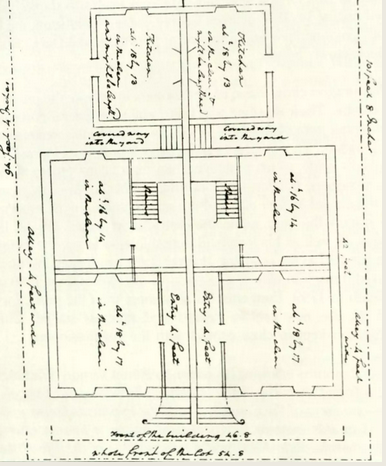

Source: https://www.mountvernon.org/george-washington/the-first-president/george-washingtons-townhouses-in-capitol-hill

Then Washington added: "My plan when it comes to be examined, may be radically wrong; if so, I persuade myself that Doctr Thornton (who understands these matters well) will have the goodness to suggest alterations."(5)

That certainly isn't a request for his plan to be examined by Thornton. However, there are no more letters extant between Washington and White about the houses. There is an interesting file of letters about the houses between Washington and Thornton. The contract between Washington and the builder George Blagden is also in Thornton's handwriting. In addition, there is evidence in other letters that Washington saw a "plan of Doct. Thornton's" two weeks before he sent his plan to White. 

Such evidence can be construed as proof that the General must have bowed to the architect when designing his houses. But on close examination, that evidence doesn't hold up.

On August 27, 1798, Washington sent Thomas Peter a brief letter about a monetary transaction, and then added: "Doctr Thorntons plan is returned with thanks; our love to Patsy." Peter had visited Mount Vernon the day before, and Patsy was Martha Washington's grand daughter and Peter's wife. Two days later, Peter acknowledge his receipt of "Doctr Thorntons Plan."

For an explanation of that plan, the editors of Washington's papers refer readers to "Peter to GW, 18 Oct. 1798, in Harris, Thornton Papers 1:473–74." Actually the letter in question is GW to Thornton and in it Washington doesn't discuss the design of the houses, but it is the first letter he wrote to Thornton in which he mentioned the houses. In their commentary on the letter, the editors of Thornton's papers note that Washington first mentioned the houses in a September 12 letter to Alexander White, and note that Washington "had reviewed a plan that WT apparently prepared for Thomas Peter...." They refer the reader to Washington's August letter to Peter. 

By associating Washington' October letter discussing his houses with two August letters mentioning "Doctr. Thorntons plan," the editors imply that the plan Peter shared with Washington informed the design of his houses. Ergo,the ideas of Thornton informed the design of the houses.(6)

However, "Dr. Thorntons plan" likely had nothing to do with house design. The first documentary evidence that Thornton made a plan for Thomas Peter is May 1808 when Thornton's wife noted that her husband "drew a plan for Peter."(7) Historians believe that was one of his many designs for Tudor Place, the Peter's mansion in Georgetown completed in 1815. 

In 1798, Peter, Washington and Thornton had something in common that explains why they would all be interested in a plan made by Thornton. They all owned lots around the public reservation slated to be the site of the National University which was a dream Washington had cherished for years. He had also donated his Potomac Company stock to help fund it. Stock in a company that would charge tolls at the locks around the falls of Potomac had to one day be very valuable. 

Thornton owned two lots in Square 33 and a large wooden house there that he rented out. Washington owned lots in Square 21, and the Peter family owned the houses in Square 22, as well as many of the lots in the area that they retained by virtue of owning the land in 1791.(8)


In January 1796, Washington asked the commissioners if anyone was working on a "plan" for the National University. Thornton told his colleague Alexander White that he was working on a "plan" for the university and soon wanted to pass it around to friends for comment. Since at that time the site of the university was up in the air, Thornton was likely referring to the curriculum and organization of the university. In the fall of 1796, Thornton persuaded the president to place the university on Peter's Hill. The draft of his letter to president begins "the wish you have so frequently expressed of seeing an university founded at the seat of government upon the most extended plan...." His draft of a memorial to be sent by the commissioners to congresses urges authorization for "promoting a plan" for the University. Congress briefly debated a memorial but did nothing.(9)

Thormton's plan in 1798 was likely a map showing the sites of the school's buildings on Peter's Hill which judging by the draft of the letter he sent to the president would include "the national library, museum menage, school for the mechanic arts, and many other appendages to the university..." In a December 26, 1800, diary entry, Mrs. Thornton wrote, "Mr. Blodget making a sketch of Dr. T's plan for our University on Peter's Hill."(10) In 1798, with Thornton's plan in hand, Washington and the Peter family would know how their lots related to the library, museum and schools of various arts.

Washington's reference to Thornton in his September 12 letter to White can be taken as an appreciation of Thornton's genius but not when it was written to White and not when it was written about "plain" houses. Washington wanted to rent his houses to a hotel keeper who would board congressmen when congress convened in the city in December 1800.

George Washington's houses, source: https://www.atlasobscura.com/places/george-washingtons-townhouse-lots

When rubble was needed during construction of the New Capitol much of the ground in front of the buildings were removed. A new bottom story was added to get the houses closer to the street. Today, the whole hill is a street level slope toward Union Station and the houses are long gone with only a plaque like a gravestone marking the spot. Its inscription credits Thornton for designing the houses. Thornton did not build the third house.

White was a Virginia lawyer and former congressmen who Washington made a commissioner to keep a check on Thornton who in his first six months as a commissioner seemed more interested in thwarting investment in the city and lobbying for a Capitol even grander than the one he designed. He wanted to undo changes made to his design, and his   arguments relied heavily on British books on architecture., especially Colen Campbell's Vitruvius Britannicus and William Chambers' Treatise on Civil Architecture. At least in his own mind, Thornton established himself as the resident expert. 

For example, in January 1798, Thornton chided his colleagues for not having a rose on top of a pilaster recut so that it would be 1 and 3/4 inch larger, Thornton wailed that the mistake "will remain, forever, a laughing stock to architects." It was "not in the proportion recommended by Sir Wm. Chambers in his work on architecture...." Then White went to Philadelphia and while there, he tried to procure mahogany for the doors of the Capitol. A deal fell through and rather than possibly delay progress on the building, he and Commissioner Gustavus Scott voted to have pine doors with a mahogany finish. Thornton dissented. It was his shortest dissent but included his usual refrain. They must do what was "recommended by the best writers in architecture...."(11)

After getting the September 12 letter from Washington, White asked his colleagues for advice on two favors Washington asked for in the letter. He wanted commissioners to get title to the two lots he wanted on Capitol Hill and to make a contract with a reputable builder. That likely was when Thornton first learned of the project.(12).

There is no evidence that Thornton offered written advice on the design. On September 21, along with his colleagues, he was with the president as he chose his lots. But there is no evidence that he talked about the design. That same day he wrote to his colleagues asking  them to give him the other part of his prize for designing the Capitol.  Along with $500, he had won but did not claim a building lot in the city. He then began to arrange that the prize lot was one of the two lots next to lot the president's lots. He did not inform the president about the arrangement until October 25.(13)

Thornton took pains to involve himself in the project, but not to change Washington's design. In that October letter he offered to build a house next to Washington's and bear the  full expense of the party wall after getting specifications for the wall from Washington's builder. That said, he allowed that he did not yet have the money to start building. Washington's graciously welcomed the party wall and didn't want Thornton to pay for it all. He never built on the lot.

Meanwhile, through October negotiations continued with the builder. As Thornton put it in a letter to the president, he and White "formed" a contract that specified dimensions and building materials. The final copy of the contract was written in Thornton's handwriting which suggests he, more than White, drew up the contract. However, a letter Washington wrote to commissioners on November 5 describes a contract hammered out by himself and the builder, who came to Mount Vernon on October **. Thornton wasn't there. In a letter to the commissioners, Washington wrote: "The agreements are drawn on unstamped paper; but I presume it may be stamped in George Town. If it cannot be done there, Doctr Thornton will be so good as to have new agreements drawn for me on stamped paper." Although the final document was only in Thornton's hand because he was also a county magistrate who could make documents official, the editors of Thornton's paper suggest that in drawing the contract, Thornton made design decisions that "extended to such details as the selection of molding."

In his October 18, before the contract was finalized, Washington told Thornton that he hoped to save money by having his slaves do some of the carpentry. He asked Thornton to get Blagden to particularize exactly what he needed. by way of planks and scantling. Plus, "it would be expected of him too, to give the moldings and dimensions of such parts of the work as would be prepared by my own people at this place."

Thornton replied that after asking Blagden for the dimensions, "I meant to obtain a specimen of different moldings, thinking your people could work better by them, than by drawings." That hardly seems to be a design decision and nothing came of it since once he met with Blagden, Washington decided not to use his slaves.(14)

Once the contract was signed Washington would be obliged to send money to the builder to buy building materials. He had sent his money for the two lots to the commissioners even though one lot was privately owned. Realizing it may seem unseemly to have the commissioners pay his builder, he asked Thornton to privately do that for him. In his October 28 letter, he wrote: “as you reside in the City, and [are] always there, and have moreover been so obliging as to offer to receive the Bills and pay their amount (when presented by Mr Blagden) I will avail myself of this kindness.” Of course, Thornton agreed. By doing so, he guaranteed an on-going correspondence with George Washington until the house was finished.(15)

Questions about the design did come up in their correspondence. For example, in a December 21, 1798 letter, Thornton advised Washington to put a parapet on the roof of his houses. Characteristically, he noted that the City of London made it a rule that houses have parapets. Washington didn't take that advice. A clash of quotes all but proves that Washington's assuring White that Thornton would correct errors was a joke between the two men which alluded to the inevitability of Thornton finding fault.

Washington wrote: "I saw a building in Philadelphia of about the same front and elevation that are to be given to my two houses, which pleased me. It consisted also of two houses united - doors in the center - a pediment in the roof and dormer window on each side of it in front - skylights in the rear. If it is not incongruous with rules of architecture, I should be glad to have my two houses executed in this style."

Thornton wrote back: "it is a desideratum in architecture to hide as much as possible the roof - for which reason in London, there is a generally a parapet to hide the dormer windows. The pediment may with propriety be introduced, but I have some doubts with respect to its adding any beauty."

Washington replied: "Rule of architecture are calculated, I presume, to give symmetry, and just proportion to all the orders, and parts of the building, in order to please the eye. Small departures from strict rules are discoverable only by skilful architects, or by the eye of criticism, while ninety-nine in a hundred - deficient of their knowledge - might be pleased with things not quite orthodox. This, more than probable, would be the case relative to a pediment in the roof over the doors of my houses in the city.(16)

That was the second time Thornton used his experiences in London to try to instruct the General. In late October Thornton suggested that despite local building regulations, the houses destined to entertain boarders be set back just as they were in London to accommodate large casks and make a subterranean kitchen more airy. Washington agreed but declined asking the board to change a regulation he had proclaimed and Thornton enforced. (17)

Thornton was involved in a design change but only as a conduit of information between Washington and the builder.

In his response to a letter Thornton sent that has not been found, Washington wrote: "Your favor of the 28th instant, enclosing Deeds for my Lots in the Federal City—and Messrs Blagden & Lenthals estimate and drawing of the Windows—dressed in the manner proposed—came to my hands yesterday. The drawing sent, gives a much handsomer appearance to the Windows than the original design did; and I am more disposed to encounter the difference of expence, than to lessen the exterior show of the building—& therefore consent to the proposed alteration."1 Thanks to the way the letter was written, it is not clear who proposed the change in the design. It may well have been Thornton. However, either Blagden or his partner Lenthals, who was a carpenter, made the drawing. There are no more discussions of the design of the houses that Thornton never claimed credit for designing.(18)

Historians who don't credit Thornton for designing the houses credit him for superintending or overseeing their construction. That implies that after reviewing the design and contract, Thornton could rely on his understanding of building techniques and the cost of building materials to prevent cost over runs and delays. Thornton seemed as clueless as his colleagues

Washington bristled at Blagden's $12,982.29 estimate of the cost of the houses. He knew that Thomas Law had contracted to build a house, "not much if any less than my two," for under $6,000. Washington said he had calculated it would cost $8,000, or $10,000 at most. Washington decided "to suspend any final decision until I see Mr Blagdens estimate in detail, with your observations thereupon; and what part of the work I can execute with my own Tradesmen, thereby reducing the advances."

In the commissioners' reply, signed by Thornton, they assured him of Blagden's integrity, allowed that they were unable to say if the estimate was reasonable and regretted that the only man in their employ who could was at the time "confined by indisposition." That was James Hoban, architect of the White House, who, unlike Thornton, was a real architect.(19).

Rather than the novice Washington taking advice from the man who a century later would be proclaimed the greatest American architect of the 18th century, Washington schooled Thornton in building techniques. He reminded him to get window sashes painted before installation, instructed him on the proper mixture of sand in the paint for the walls and lectured him on plaister of Paris. After that lesson, Thornton referred Washington to a pamphlet on the subject written by a Pennsylvania judge. While president, Washington had asked the judge to do the research and write the pamphlet.(20)

However, there was a contemporary who credited Thornton for superintending the houses. In her diary, Mrs. Thornton noted apropos the houses that "the money paid to the undertaker of them having all gone thro' my husband's hand, he having Superintended them as a friend." And as a friend,Washington did not hold Thornton responsible for when the work began and how it progressed. A real superintending architect never got off that easily. 

After signing the contract, Washington naively expected the contractors to make preparations for building. Washington was shocked to learn in March 1799, that nothing had been done to prepare the site or have building materials delivered. That would have been the responsibility of the superintending architect, if he had one. He didn't blame Thornton,(21)

Work on the houses began in the second week of April. In an April 19 letter, Thornton described what Blagden had done thus far. He also briefly acted like a supervising architect: "I visited the workmen the Day before yesterday, & they progress to my Satisfaction. I took the liberty of directing Stone Sills to be laid, instead of wooden ones, to the outer Doors of the Basement, as wood decays very soon, when so much exposed to the damp; but I desired Mr Blagdin would do them with as little expense as possible." Washington thanked him for the stone cills but ignored the lecture on the wood getting damp: responded that (Judging by the remaining letters he wrote to Washington, he never advised Blagden again.)(22)

Then in his April 19 letter, Thornton turned to the gossip of the day, He briefly reported the death of a mutual friends daughter as well as this item: "Mr J. Tayloe of Virga has contracted to build a House in the City near the President’s Square of $13,000 value."

While keeping Washington updated on his houses, Thornton never again mentioned the other house he supposedly designed and that was then being built. Of course, letters only provide a narrow window on what passes between people who might spend hours together in conversation. But letters we have to and about Thornton make clear that he had little interest in talking about private building. A letter from Washington's secretary to Thornton reveals the topics talked about when Thornton was at Mount Vernon. On September 12, 1799, Lear wrote to Thornton thanking him for some recent medical advice and continued

I am very happy to learn that the prospects in the city are brightening fast. You will become every day more and more important, and I have not a doubt but the improvements will be rapid beyond example. I hope the grand and magnificent will be combined with the useful in all the new public undertakings. We are not working for our selves or our children; but for ages to come, and the works should be admired as well as used. Your wharves and the introduction of running water are among the first objects. Let no little mindedness or contracted views of private interest prevent their being accomplished upon the most extensive and beautiful plan that the nature of things will admit of - and - But hold, I am talking to one who has considered and understands these subjects much better than myself...(23)

Thornton gloried in his role as the protector of the public interest and planner of public grounds. In May, Thomas Boyleston Adams, the First Family's third son, toured the city. In a June 9, 1799, letter to his mother, he described as "a democratic, philanthropic, universal benevolence kind of a man—a mere child in politics, and having for exclusive merit a pretty taste in drawing—He makes all the plans of all the public buildings, consisting of two, and a third going up. There was no mention of three notable private house then under construction: Washington's, Law's and Tayloe's.(24)

Thornton did defend the private interests of his great patron, as he saw fit. Once word got out that Washington was building, John Francis, who boarded congressmen in Philadelphia, expressed an interest in renting Washington's houses. Washington asked Thornton what the customary rent would be. Instead, Thornton turned Francis away. Since Francis also wanted to build back buildings behind Washington's houses, Thornton wrote to Washington that he “refused to name any price,” and Francis lost interest. But not to worry, if Francis hesitated to rent Washington's houses, Thornton had a better idea. He advised Washington to become a real estate developer, starting with the houses he was building:

...preserve them unrented, and keep them for sale, fixing a price on them together or separately; and I have no Doubt you could sell them for nine or ten thousand Dollars each, and if you were inclined to lay out the proceeds again in building other Houses this might be repeated to your Advantage, without any trouble, with perfect safety from risk, and to the great improvement of the City. I am induced to think the Houses would sell very well, because their Situation is uncommonly fine, and the Exterior of the Houses is calculated to attract notice. Many Gentlemen of Fortune will visit the City and be suddenly inclined to fix here. They will find your Houses perfectly suitable, being not only commodious but elegant.(25)

Washington didn't react to Thornton's suggestion. But the General almost plunged. Washington saw a lot that struck his fancy. Carroll owned it and Thornton inquired about its price. One benefit of Washington's building on Capitol Hill had been that it increased the value of all lots in the vicinity. Carroll could not lower his price just for him and assume other buyers would understand and gladly pay more. Washington lost interest and gave an excuse reserved for all gentlemen: he had expected that closing another deal would give him the means to proceed, but that deal fell through.(26)

Throughout the back and forth, there is no evidence that Thornton offered to design a house, not even one for the lot he owned next to Washington's. A New England gentleman bought the lot on the other side of Washington's houses. In an August 1 letter, Thornton told Law that he called on him "to recommend houses like the Generals,... but I think he has not yet determined what to do."(27)

In one letter he sent to Washington that summer, Thornton did mention seeing Tayloe. The first clearly documented meeting between Thornton and Tayloe took place on Saturday, August 31, 1799, while the Octagon was being built. Thornton even canceled a visit to Mount Vernon. He wrote to Washington that instead he and his wife "spent the day" with "John Tayloe of Mount Airy."1 Thornton did not report what they did that Saturday. Did they begin the day examining the foundation of the Octagon house and then go out to Thornton's farm to see his horses? Thornton imported two thoroughbreds in 1799 and Tayloe imported several*.

Thornton also had a reason not to go to Mount Vernon once his and his wife's day with Tayloe was done. He planned to see William Hamilton who had to return to Philadelphia "immediately." Hamilton's Woodlands had oval rooms like ones then being built in the Octagon, but he was also a connoisseur of garden plants and may have heard about Thornton's illustrations for the unpublished Flora Tortoliensis.

Thornton's letters to Washington were rarely short. In his September 1 letter, he did not pick up on the theme of his July 19 letter, no more analysis of the house rental market. Instead, he noted a letter that Secretary of State Pickering sent to the former president that the latter forwarded to the commissioners. Pickering offered a plan for the capital city's docks that would prevent yellow fever. Thornton noted that "it is a highly interesting subject and one I have urged, for three years to the board."

The conjunction of Tayloe and Hamilton, men with oval rooms, did not inspire Thornton to develop that theme. Instead, he noted that "the navy- yard will be fixed... where I recommended it." He had prevented it from being placed on the square designated for the Marine Hospital. He also had preserved the "point" for "a military academy, for parade-ground, for the exercise of the great guns, for magazines, etc., etc." Then he found even higher ground: "I am jealous of innovations where decisions have been made after mature deliberation, and I yet hope that the city will be preserved from that extensive injury contemplated by some never-to-be-content and covetous individuals." Thornton clearly had a higher mission than designing residential houses.(28)


1. Chernow, George Washington. p. 794; Brown, Glenn, "Dr. William Thornton, Architect, Architectural Record, 1896 , Vol. VI, No. 1 July-September (page 53ff)

2. Mary Carr, Thomas Wilkinson: A Friend of Wordsworth, p.11, Headley Bros., London, 1905.

3. Mrs. Thornton' s Diary, p. 90. https://www.jstor.org/stable/40066957

4. https://www.mountvernon.org/george-washington/the-first-president/george-washingtons-townhouses-in-capitol-hill 

5.GW to White, 12 September, https://founders.archives.gov/documents/Washington/06-02-02-0471 

6. https://founders.archives.gov/documents/Washington/06-02-02-0471 Harris, Papers of William Thornton, vol. 1,  p. 453.

7. Anna Maria Thornton (AMT) notebook reel 3 image 40, LOC: https://www.loc.gov/resource/mss51862.001_0351_0600/?sp=40&st=image&r=-0.239,-0.129,1.22,0.454,0

8. United States Congressional serial set. 5407.,  #765, page 13, Hathi Trust; https://babel.hathitrust.org/cgi/pt?id=uc1.b3991082&view=1up&seq=765&skin=2021&q1=Thornton

9. Thornton to GW 13 September 1796, Harris, Papers of William Thornton, pp. 395-97, WT to GW, draft letters 13 September, 1 October, draft memorial 18 November, 1796, Harris pp. 395 - 403

10. Mrs. Thornton diary, December 26, 1800, p. 225.

11.Stuart to GW 22 February 1795, https://founders.archives.gov/documents/Washington/05-17-02-0377; GW to White, 17 May 1795, https://founders.archives.gov/documents/Washington/05-18-02-0115; WT to Commrs., 10 January, 1798,Harris, pp. 430-2, 453.

12. White to GW, 8 September 1798 https://founders.archives.gov/documents/Washington/06-02-02-0463;  Commrs to GW, 27 September, 3, 4, 15, 25, October 1798; GW to Commrs. 28 September 4, 17, 22, 27 October 1798

13.  GW Diary; WT to Commrs 21 September 1798, Harris pp. 472, 475; WT to GW 25 October 1798 https://founders.archives.gov/documents/Washington/06-03-02-0101

14. Harris p. 586 ; GW to WT, 18 October 1798, https://founders.archives.gov/documents/Washington/06-03-02-0076 ; WT to GW, 25 October 1798, https://founders.archives.gov/documents/Washington/06-03-02-0101; for contract see https://founders.archives.gov/documents/Washington/06-03-02-0106

15. GW to WT 28 October 1798, ;https://founders.archives.gov/documents/Washington/06-03-02-0108

16.  GW to WT, 20 December 1798, https://founders.archives.gov/documents/Washington/06-03-02-0187; WT to GW 21 December, 1798, https://founders.archives.gov/documents/Washington/06-03-02-0189; GW to WT 30 December 1798, https://founders.archives.gov/documents/Washington/06-03-02-0207

17. WT to GW, 25 October 1798; GW to WT 28 October 1798 

 19. GW to Commrs. 4 October 1798, https://founders.archives.gov/documents/Washington/06-03-02-0041 ; Commrs to GW, 4 October 1798, https://founders.archives.gov/documents/Washington/07-01-02-0008

20. GW to WT, 30 January, https://founders.archives.gov/documents/Washington/06-03-02-024829; 1 1 October, https://founders.archives.gov/documents/Washington/06-04-02-0282; 1 December 1799,https://founders.archives.gov/documents/Washington/06-04-02-0379 ; WT to GW, 5 December 1799,https://founders.archives.gov/documents/Washington/06-04-02-0388; Harris, p. 515.

21. GW to Lear, 31 March 1799; https://founders.archives.gov/documents/Washington/06-03-02-0344

22. WT to GW, 19 April 1799, https://founders.archives.gov/documents/Washington/06-03-02-0375; GW to WT 21 Apeil 1799, https://founders.archives.gov/documents/Washington/06-04-02-0005

23. Lear to WT, 12 September 1799, Harris

24. T.B. Adams to Abigail Adams, 9 June 1799, https://founders.archives.gov/documents/Adams/04-13-02-0248

25. WT to GW 19 July 1799, https://founders.archives.gov/documents/Washington/06-04-02-0161 ; GW to WT, 1 August, 1799,https://founders.archives.gov/documents/Washington/06-04-02-0180 .

26.  Law to GW, 10 August 1799, https://founders.archives.gov/documents/Washington/06-04-02-0194 ; GW to Law, 21 September 1799, https://founders.archives.gov/documents/Washington/06-04-02-0264 

27. WT to Law, 1 August 1799, Harris p. 505

28.  WT to GW 1 September, 1799, https://founders.archi(ves.gov/documents/Washington/06-04-02-0236


1. https://founders.archives.gov/documents/Washington/06-02-02-0440

3. https://www.loc.gov/pictures/item/95860840/ 

4. https://www.loc.gov/pictures/collection/cph/item/2002712363/

5. https://www.loc.gov/resource/mss51862.001_0351_0600/?sp=40&st=image&r=0.334,-0.043,0.625,0.233,0


1


Tuesday, October 29, 2019

Who designed the Octagon - Part Three


I have created blog re-examining Thornton's work as as architect. Here is link to the table of contents of the blog which is organized as a seventeen chapter book:

 https://ingeniousa.blogspot.com/2023/01/table-of-contents-case-of-ingenious-a.html


Would you have asked William Thornton to design your house?


As of 1799, the US Capitol was the only building in Washington that Dr. William Thornton was known to have had a role in designing. But it was notorious that his original 1793 design was not buildable. Controversy about that flared up again in 1799. Yet Thornton was a formidable influence on the city's architecture because by attacking changes professional architects made to his Capitol design, he became the city's first architecture critic. He defended his own design and attacked others with considerable rhetorical skills including references to buildings and houses in Europe.

He had added influence because as one of three Commissioners overseeing the city's development, he had power over what happened in the city. That power was largely undefined. For example, there was no formal process of approving house designs, but Thornton boasted of doubling the sale price of lots to block construction of a row of houses on Capitol Hill because the design "was destitute of taste and loaded with finery."

So apart from evidence noted in Parts One and Two of this essay, there are two other factors to weigh before deciding who designed the Octagon. Given the continuing controversy over Thornton's Capitol design, was it wise to ask him to design a private house? Then again, given Thornton's rhetorical command of architecture and his power as a Commissioner, was it wise to ignore him?

Ironically the man who chose Thornton's design of the Capitol in 1793 and who appointed Thornton to the Board of Commissioners in 1794 faced that dilemma in 1798. George Washington had to decide how much to involve Thornton in his own building project. Analyzing the ample evidence of how Washington handled Thornton might help us understand what Thornton's influence on the Octagon design process might have been. That was a process about which we have meager evidence.

George Washington spent $12,000 to build the two houses with the double doors. Admiral Wilkes bought the houses for $4000 in the 1830s. In the 1840's Wilkes returned to the city and found the side of the hill dug out for gravel to be used for walks around the Capitol.

In September 1798 when Washington decided to build two houses on Capitol Hill, much had passed between him and Thornton since 1793. The plan Thornton submitted in the Capitol design contest was a godsend that quickly turned into a nightmare. Washington had originally planned to have L'Enfant design the Capitol and President's house. In March 1792 after having only made his plan of the city, L'Enfant left the project. Washington had the Commissioners announce a design contest for each building with a $500 prize, plus a lot in the city for the winning Capitol design. In July 1792, James Hoban, a 30 year old Irish architect who since 1787 had been designing and building houses in Charleston, South Carolina, marked out the lines of the President's house. Washington was at his side making sure the house was bigger than Hoban's winning contest entry design.

A French architect, Stephen Hallet, who had recently left Paris for Philadelphia, almost had a winner for the Capitol but Washington was not moved by his entry. The Commissioners let Hallet move into a house in the city hoping he would come up with revisions to please the president.

Washington feared that not building the Capitol and President's house at the same time would excite the rivalry that already existed between the East and West ends of the city. Still, Washington had the Commissioners reopen the design contest for the Capitol. That gave Thornton the chance in January 1793 to submit a design which he had “worked on night and day” during his extended honeymoon on his family's plantation in the Virgin Islands. He had left the island of Tortola when he was 5 years old to be educated in Britain. After getting a doctorate in medicine in Scotland, Thornton decided to make his career in Philadelphia where in 1790, the 31 year old doctor quickly made a sensation with an essay on language, an award winning design for the Library Company of Philadelphia's new building, and his marriage to the 15 year daughter of the headmistress of the city's premiere finishing school.

For the rest of his life upon meeting another influential gentleman, Thornton gave him a copy of his prize winning essay. That gentleman could not help being impressed

Both Washington and his right hand man in the Capitol project, Secretary of State Thomas Jefferson, were taken “by the beauty of the exterior and the distribution of the apartments.” Thornton went to Georgetown to deliver his plan. Directed by the enthusiasm in Philadelphia, the Commissioners awarded Thornton the $500 prize and asked him to lay out the foundation as soon as possible.  He surprised the Commissioners by suggesting they ask an architect to do it. He also didn't have any idea how much his design would cost to build.

The two architects already employed by the Commissioners, Hallet and Hoban, warned the Commissioners, and then both Washington and Jefferson when they passed through Georgetown, that Thornton's design was far too expensive and, as designed, parts of it could not be built. Both the president and Commissioners had pledged themselves to grandeur for the ages despite the expense but....

On June 30, 1793, Washington asked Jefferson to arrange a meeting with Thornton and his critics, adding: “It is unlucky that this investigation of Doctor Thornton’s plan, and estimate of the cost had not preceded the adoption of it;... I had no knowledge in the rules or principles of architecture—and was equally unable to count the cost.”

To be fair to Thornton, Washington asked Jefferson to convene the meeting in Philadelphia where Thornton lived and planned to practice medicine. Plus Thornton could invite two builders to the meeting to defend his design. Jefferson also sent Thornton “five Manuscript Volumes in folio” (20 pages, which have been lost) in which Hallet attacked Thornton's design. In Thornton's papers there is a draft of a letter of just over 2000 words long in which Thornton defended his design. He sent the final version to Jefferson.

Judging from Thornton's reaction, Hallet exhausted himself challenging (in his second language) the details of Thornton's design. Thornton admitted being frustrated by not having a copy of his design and by Hallet's bad handwriting. Thornton admitted to a few mistakes and then set out to prove that he knew more about architecture than the French architect. In his letter Thornton referred to the Ancients, the Escorial, the Louvre, and he put the Capitol in context: “It is but of small magnitude when compared to many-private Edifices of Individuals in other parts of the World.” 

Detail of 1722 painting of El Escorial by Houasse
That this huge royal complex in Spain took 21 years to build was a fact Thornton thought relevant to construction of the Capitol

Hallet had a motive for attacking Thornton. Well aware of the excitement generated by Thornton's design, he sent a written description of his own latest design to Jefferson. 

Thornton did not impugn Hallet's motives but did fault him for making so much of mistakes that could be easily corrected, such as the placement of the columns to support the dome. But he doubted Hallet's qualifications to criticize the essence of his design:
The want of unity between the Ornaments and the Order, forms another objection in Mr. Hallet’s report. I trust he will permit me in this instance to prefer the authorities of the best books.... The Intercolumniation of the portico is objected. The Ancients had five proportions, (viz) the Picnostyle containing 1½ Diameter; the Sistyle 2 Diameters; the Eustyle 2¼ Dia:; the Diastyle 3 Diam:; and the Aræostyle 4 Diameters. The Eustyle is reasoned the most elegant in general, but deviations are allowed according to circumstances,....
One of Hallet's many plans
"poor Hallet, whose merit and distresses interest every one for his tranquility and pecuniary relief"
Jefferson lamented in a February 1, 1793, letter. 

Then they all met, the President attending as long as he could. The better known of Thornton's experts, Thomas Carstairs, saw the problems with Thornton's design, and his other expert, a Col. Williams, appeared to agree. All agreed that changes that Hallet made to Thornton's design were better and cheaper. Then the day after the meeting, Williams called on Jefferson and explained that conferring with Thornton, he thought all objections “could be removed but the want of light and air in some cases.” Jefferson was very skeptical, telling Washington that Williams' “method of spanning the intercolonnations with secret arches of brick, and supporting the floors by an interlocked framing appeared to me totally inadequate;... and a conjectural expression how head-room might be gained in the Stairways shewed he had not studied them.” 

No rival of Thornton's would forget the trouble with the headroom.

In his July 25, 1793, letter to the Commissioners, the President described the agreed upon design as “the plan produced by Mr Hallett,” but it preserved “the original ideas of Doctor Thornton, and such as might upon the whole, be considered as his plan.,..” And then he goes on to say: “Mr Hoben was accordingly informed that the foundation would be begun upon the plan as exhibited by Mr Hallett, leaving the recess in the East front open for further consideration.” Hallet thought Thornton's grand portico entrance with the elliptical front and grand staircase would block lighting and ventilation in the North and South Wings. In August, the President sent the Commissioners the cost estimates Carstairs made for the stone work on what the President called “Hallet's plan.”

We now don't exactly know what plans everyone was looking at because they no longer exist. By the way the Dome was not Thornton's original idea. Samuel Blodget, a land speculator who replaced L'Enfant as superintendent of all work in the city, sketched out a Roman edifice with a Dome before Thornton submitted his design.

The cornerstone of the Capitol was laid on September 18, 1793, and during the public ceremony Thornton was not recognized in anyway. Hoban and Hallet were both listed as its architects. During the winter Hallet concentrated on completing designs of sections of the huge tripartite building. Hoban shifted masons who had finished the wall of the first story of the President's house over to lay the foundation of the Capitol. No one asked Thornton for any advice least of all the Commissioners who recognized that the President made all the decisions about it and that their job was to raise money and hire workers as cheaply as possible.

Meanwhile on November 29, 1793, Thornton solicited appointment as Washington's secretary. He admitted to him that “My Situation in Life has precluded me from the honor of being but very partially known to you...,” and offered James Madison who he had befriended in Philadelphia in 1790, as a reference. Neither in Thornton's letter nor Washington's brief reply (he had appointed somebody else) was there any mention of the Capitol. 

Was Thornton being shunned for submitting a deceptive design and then trying to back it up with an incompetent expert? It is unlikely that Washington thought that badly of a young man everyone thought congenial and informative. The Commissioners soon got some use out of Thornton, at least out of his “ideas.”

As the foundation continued to rise in the early summer of 1794, Hallet gave orders to the masons which angered the head mason, a Scot named Collen Williamson, who complained to the Board. The Board had hired Williamson in 1792, and he won their gratitude by laying the founding and building the first story of the President's house. (But he was old and ever claiming that the stone castles he built in Scotland were better than the brick-infused buildings in Washington and was eventually fired.) He intimated to the Board that the drawings Hallet was using were different than what the President had sent down from Philadelphia. The Board asked Hallet to give them all his drawings.

Hallet had not exactly prospered. When Jefferson learned that his wife and children lived in poverty in Philadelphia, he was quite alarmed. When they moved to Washington, three children died. Maybe that's why Hallet overreacted to the Board's demands. He said he would give the drawings up only after they hired him as superintendent of construction, which paid $1500 a year, and credited him as the only designer of the Capitol.

At the their monthly meeting on June 26, 1794, the commissioners responded: “nothing has ever gone from us by which we intended or we believe you could infer that you had the chief direction of executing the work of the Capitol or that you or anybody else were to introduce into that building any departures from Doctr Thornton’s Plan without the Presidents or commissioners approbation.”
Hallet replied on June 28 that he believed the earlier conference had led to the adoption of his plan: “In the alteration I never thought of introducing in it any thing belonging to Dr Thornton’s exhibitions. So I Claim the Genuine Invention of the Plan now executing and beg leave to Lay hereafter before you and the President the proofs of my right to it....”( see footnote 7)

The Commissioners fired Hallet. The speculator James Greenleaf took up his cause and kept him at work refining his Capitol design as an insurance policy in case the Commissioners' maladministration delayed construction of the Capitol.

At the same that they dismissed Hallet, Commissioners Thomas Johnson and David Stuart announced their retirement – they had been threatening it since January. (Washington offered to make Johnson the sole commissioner, to no avail.) Thornton sensed an opportunity and spent most of July 1794 in Georgetown. He arrived just after the Commissioners sacked Hallet and just after Washington accepted Johnson's and Stuart's resignation. Washington made replacing Johnson a priority. Johnson, a former governor of Maryland and former chief judge of that state and former Justice of the Supreme Court, advised Washington to appoint a good lawyer to the Board.  

Washington asked two Maryland lawyers, a former governor and a former senator, but they declined. Then he asked his Georgetown contacts about Gustavus Scott, a Virginia born Maryland lawyer who had held minor offices and had done more than most in promoting the Potomac canal projects. 

Then while Thornton was in Georgetown, a member of the Fairfax family, the closest to royalty that Virginia had and long respected by George Washington, urged him to appoint Thornton, who "even with the sacrifice of considerable pecuniary interest, being desirous of fixing himself in the neighbrhood of the city of Washington, wou’d willingly accept of some appointment in w’ch his talents might contribute to the Public Advantage by advancing the growth or Prosperity of the City.”

Ferdinando Fairfax then addressed Thornton's qualifications:
From a pretty good acquaintance with him, as well as from general repute, I believe him to possess uncommon Talents, and to have cultivated particularly those Branches of Science which are most useful in this business—and, what is of equal or perhaps more consequence, to have a large share of Public Spirit, and great integrity. He has a Plan of a National University, which appears to deserve attention, and w’ch, at some convenient time, he is desirous of submitting to your Consideration.
There was no mention of the Capitol. Thornton had befriended Samuel Blodget who had initially won Washington's esteem with the same line about a National University.

Washington appointed Scott and then in late August offered the other vacancy to his former secretary Tobias Lear who was setting up a new merchant house on Rock Creek. Accustomed to men declining appointment, he also asked Lear about Thornton: “The Doctr is sensible, and indefatigable I am told, in the execution of whatever he engages; To which may be added his taste for architecture; but being little known, doubts arise on that head.”

There was no mention of the Capitol or Hallet. Note that he did not say that Thornton was an architect. Lear declined appointment and replied:
I find Dr Thornton is much esteemed by those of the proprietors and others hereabouts from whom I have been in the way of drawing an opinion; they consider him as a very sensible, genteel and well informed Man, ardent in his pursuits; but liable to strong prejudices, and such I understand is his prejudice against Hoben that I conceive it would hardly be possible for them to agree on any points where each might consider himself as a judge—Weight of Character, from not being known, seems also to be wanting.
Lear probably thought he had ended Thornton's chances by bringing up his feuding with James Hoban, the architect at the President's house whose work there had never given the President or Commissioners few problems. So Lear mentioned three others that Washington might pick but in September, the new secretary of state Edmund Randolph called on Thornton who was back in Philadelphia and offered him the job. Although there is no evidence that they met at all that summer, in coming years and after several battles with other architects over the Capitol design, Thornton would claim that Washington told him to restore the original design of the Capitol.

In his 1896 article on Thornton, Glenn Brown completely mistakes Washington's reason for appointing Thornton to the Board of Commissioners, and didn't realize that the lawyer Gustavus Scott joined the Board at the same time as Thornton and, as lawyers usually do, had a knack for forms and contracts


Actually, Washington had Randolph inform Thornton and Scott that he appointed them to reform the Board and carry out his new ideas about how it should operate. The old Board met once a month and only Commissioner Daniel Carroll lived relatively close to the city, up near the source of Rock Creek. Washington wanted members of the new Board to live in the city or for a start at least in Georgetown. Washington also expected the new Board would meet in the city three times a week and that the new Commissioners would pay close attention to the work being done. ( Daniel Carroll, the member of the old Board, who remained on the new Board, was in ill health.) The old Board was paid only their traveling expenses and a $6 per diem when they met in Georgetown. To make their new burdens easier, each member of the new Board would get a salary of $1600.

Thornton left Philadelphia and bought and moved into a house in Georgetown in October. Washington had just bought lots on a hill in the city just southeast of Georgetown and planned to build his city residence there. Thornton bought lots in the neighboring square. Scott commuted from a farm he owned nine miles from the city in Virginia and also began buying up city lots.

But a few months on the job, Thornton seemed to show that he understood Washington's wishes. He personally took the level of the ground around the Capitol. That drew attention to what many thought was Washington's obvious mistake in having L'Enfant place the Capitol too far to the west on Capitol Hill. Since 1791 when L'Enfant showed his plan, Washington had resisted moving it back. Then after crews of Irishmen, most speaking only Gaelic, dug the foundation, and masons, mostly Scots, laid the foundation as hired slaves moved stone to the site, the Capitol hardly seemed to rise because of the ground hulking behind it. Hallet had recognized the problem and had estimated how much it would cost to remove the hill.

The old Board assumed that brick-makers needing clay would level the hill in due time. While the building's foundation was stone, its walls would be brick fronted with sandstone. Thornton went to Philadelphia in March 1795 to do the paper work to get a bank loan to finance construction of the public buildings. Since he periodically had money from his legacy transferred from London, he knew Philadelphia bankers. (He didn't manage to raise a loan but it wasn't his fault.)

While in Philadelphia, he suggested to Washington that the foundation be raised ten feet. Thornton told his colleagues what he was up to and added, by the way, that both he and the President agreed that the Capitol was a building for the ages and it would not do to spare expense. Washington put off any decision until he viewed the site. One can credit Washington's eventual decision to raise the foundation walls six feet as an endorsement of Thornton's vision, although Washington probably felt compelled to rectify the mistake he made when he placed the Capitol too far to the west.
Washington was likely gratified that Thornton seemed to have thoroughly investigated the situation which is exactly what he wanted the new commissioners to do.

Then Thornton and Scott started a row with Thomas Johnson, the man Scott succeeded. Johnson had long worked with Washington to develop the Potomac Valley. When he first mentioned retiring, Johnson wrote to his old friend that he thought it was time "benefit myself by the rise of the City." He bought lots from James Greenleaf along Rock Creek just north of the stone bridge at K Street NW. When Johnson tried to get the deeds for the lots, the two new members of the Board told him that the old Board had not been authorized to award what were in effect water lots to Greenleaf.

Thornton enraged Johnson. So he who had used the “ideas of Thornton” in order to fire Hallet, took aim at Thornton. Alluding to his head bumping design of the Capitol's interior Johnson jibed in a letter that Thornton had a “head to clear of the lumber which crowds it to make room for what is correct.” Thornton and Scott sent a packet of documents and Johnson's offensive letters to the President. (See footnote 3.)

Washington tried to mediate the dispute and found both Johnson and Thornton stubborn. In a letter to Commissioner Carroll, he described his conversation with Thornton:
He, any more than Mr Johnson, seemed to think this could not be accomplished, as the Commissioners (or whether he confined it more particularly to Mr Scott and himself, I am not certain) were clearly of opinion, and had been so advised by professional men, that the lots upon Rock Creek would, undoubtedly, be considered as water lots under Greenleafs contract; and being so considered and of greater value, it followed as a consequence, that they, as trustees of public property in the City, could not yield to a claim which would establish a principle injurious to that property. He added that they had taken pains to investigate this right, and was possessed of a statement thereof which he or they (I am not sure which) wished me to look at. [(According to Tobias Lear, no one in Georgetown thought they were water lots.]
Learning that Carroll was about to retire, Johnson warned the President that his choice for replacing Carroll was crucial.  The other former Commissioner, David Stuart, told Washington that the two new Commissioners were "in error" and he had to appoint "a Law character of consderable eminence." He suggested Alexander White and Washington picked the 57 year old former two term Virginia congressman who had a farm in Woodville near Leesburg.

In explaining to White what he expected of him as a Commissioner, Washington shared his disappointment with Thornton and Scott:
In short, the only difference I could perceive between the proceedings of the old, and the new commissionrs result⟨ed⟩ from the following comparison. The old met not oftener than once a month, except on particular occasions; the new meet once or twice a week. In the interval, the old resided at their houses in the country; the new reside at their houses in George Town. The old... were obliged ⟨to⟩ trust to overseers, and superintendants to look to the execution; the new have gone more into the execution of it by contracts, and piece work, but rely equally, I fear, on others to see to the performance. These changes (tho’ for the better) by no means apply a radical cure to the evils that were complained of, nor will they justify the difference of compensation.... 
Then on June – before White joined the Board, all of that year's work to date which entailed raising 300 feet of foundation walls for all three parts of the building, all fell down. Work resumed only on the North Wing. Both houses of congress would have to meet there in 1800. Washington did not lecture Thornton and Scott. He left that to Secretary of State Randolph who put it this way: "The President will by no means suppose, nor does he mean in the most distant manner to insinuate, that due attention was not paid by the Commissioners to the running up of the walls of the Capitol, but it may happen in some other instance that a similar fatality might take place which would be prevented by the watchful inspection of the Commissioners...."

From the Secretary of State's letterbook

Thornton and Scott wrote to Randolph complaining of the “motley set” they had to deal with which made inspecting the work distressing. They insisted that if they had walked on top of the faulty walls three time a day, they couldn't have prevented their collapse

Despite the strain the collapse of the walls caused between the Commissioners and President, everyone conspired to minimize reports of the damage. The Commissioners conducted an investigation only to assign blame so that the culprit would pay damages. So for years they carried on their account book that contractor Cornelius McDermott Roe owed $1264 for damages to the North Wing and $1470 for damages to the South Wing. On April 22, 1795, Roe had written to the Commissioners asking for the architect to give directions. Evidently he didn't receive an answer. No one investigated the Board's role in the collapse.

Then to save the Capitol from further blunders, upon the recommendation of the American artist John Trumbull, George Hadfield arrived from England having just graduated from the best architectural training in England and with the highest recommendations. The Commissioners hired him to do what Hallet had found impossible to do, build the plan which in one letter Washington would refer to as “nobody's.”

After being on the job but a few months Hadfield complained both about the design handed to him and the defective work already done on the building. He recommended not building the basement, which is to say, a story above the foundation and below the story with the Senate chamber. To add height to the building, he recommended building an attic. Thornton found an ally in James Hoban whose Irish friends working at the Capitol took an instant disliking to Hadfield. In a 2200 word letter to Washington, Thornton referred to Hoban 11 times including this fillip: “Mr Hoban we know to be a practical man, and a person on whom I think we may depend. He has sometimes opposed my wishes, but I knew his motives were good, and I always admire independence.”

To excuse defective workmanship, Thornton relied on Hoban's judgment: “Mr Hoban and I knew of these defects, not only in the foundation but also in some parts of the distribution of the interior—we lamented, and endeavoured to correct them—In some Instances we succeeded, some small ones may yet remain, but not of much Importance in our Estimation.

As for Hadfield's criticisms of the building's design, Thornton was gracious to a point: Hadfield was “a young man of genius,” but incompetent. Thornton especially focused on one criticism made by Hadfield:
No objection can be urged to a rusticated Basement, because such are made use of not only in some of the most beautiful remains of Antiquity but also in the most magnificent modern Houses in England & other places—I will only instance a few in England. Wentworth House, which is an elegant palace belonging to the Marquis of Rockingham, six hundred feet in length—and of the same Order viz. the Corithian with a rustic Basement—Worksop-Manor House belonging to the Duke of Norfolk, three Hundred feet in extent yet only a small part of a superb Building once contemplated—Same Order rustic Basement. Holkham House—345 feet—Heveningham Hall, which is a very elegant Structure has a line of Pilasters supported on a rustic Arcade that runs the whole length—Chiswick House, the Seat of the Duke of Devonshire has a rustic Basement supporting fluted Columns of the Corinthian Order—Wentworth Castle, Seat of the Earl of Strafford abt 6 miles from Wentworth House is of the same Order on a rustic Arcade. Wanstead House is also Corinthian on a rustic Basement, & considered as a very chaste & beautiful Building—It was designed by the Author of the Book on Architecture called the Vitruvius Britannicus—These may serve to shew that a Basement (rusticated) is not only proper, but adopted by many of the first Architects. The expense is certainly less than any other mode of obtaining the same height.

Wanstead House, built in 1722, was the last of six private houses in England with basements that Thornton brought to the attention of George Washington. It was demolished in 1825 just before the original US Capitol was finished

Washington's reaction to that Vesuvius of Basements was muted. He wrote to Thornton on November 9, 1795: “If [Hadfield] is the man of science he is represented to be, and merits the character he brings; if his proposed alterations can be accomplished without enhancing the expence or involving delay; if he will oblige himself to carry on the building to its final completion; and if he has exhibited any specimens of being a man of industry and arrangement I should have no hesitation in giving it as my opinion that his plan ought to be adopted....”

In a letter to the Commissioners written the same day, he said he was busy with the upcoming session of congress. As for Hadfield's suggested changes “I should have no objection as he conceives his character as an Architect is in some measure at stake – and inasmuch as the present plan is no body's, but a compound of every body's....”  He left the decision on the basement up to the Commissioners. However, on his last visit to the city, he was told that the dome had been eliminated from the plan which he did not like at all. Indeed, Thornton penned a new design with a huge cupola thrust high by columns letting light into all the rooms below. Washington did get the dome back, although he didn't live to see it built.

As long as he was a Commissioner, at least through 1800, Thornton worked on the designs of the Capitol at his own behest. This may have been one that shocked Washington into fearing that a dome was no longer part of the design

Ten years later President Thomas Jefferson would enjoy collaborating with Benjamin Latrobe as he designed and built the South Wing of the Capitol. Washington did not want to collaborate with Thornton at all. He wanted Hadfield to supervise construction of the Capitol to its completion. And he wanted the Commissioners to be on the scene making sure that the work progressed. Washington made it clear in a June 6, 1796, letter to the Board's treasurer William Deakins that the Commissioners must live in the city, that living in Georgetown wasn't enough. But not until December 1796, did Thornton arrange to move into the rental at 1331 F Street NW that became his home for the rest of his life. Washington congratulated him for choosing such a central location. (Not until February 1798, almost a year after Washington left office, did Mrs. Thornton host her first tea there.)

Washington's gratitude was probably genuine because Thornton's colleagues never moved to the city. Scott had bought a small house just over the city's boundary and expanded Rock Hill into a house suitable for his family of nine. White didn't move to the city because after a stay of a few weeks, his wife refused to live there. Anyway, his main contribution was lobbying congress for loan guarantees which kept him Philadelphia for months when congress was in session. That also kept him near the president who found the former congressman reliable and trustworthy.

But Thornton's tardy move must have puzzled Washington because Thornton had money and just after Washington bought lots in 1794, Thornton bought lots nearby. That created the expectation that Thornton would make a major commitment to the city. In 1794 Washington expected to make a major sale of his Westernlands but when the land deal failed (it was probably with Greenleaf and Morris,) Washington forgot about building. So did Thornton, but he still had money to spend on housing. Just as he did in Philadelphia when he gave up his short lived medical practice (just in time to miss the deadly 1793 yellow fever epidemic,) he bought a farm just outside the District of Columbia. It was not too much farther from his house in Georgetown to his farm, then it was to the Capitol.  He also bought city lots cheaply when proprietors put up their less desirable lots for auction.

One of the squares in which he bought lots in May 1797 was across the street from the lot Tayloe bought in April. Likely Thornton had an eye on the long projected development around the planned Mall to the east of his lot where foreign governments would be required to build their embassies. Thornton also noticed the emergence of mud flats in the Potomac south of the President's house, and beginning in September 5, 1795, obtained warrants to register a claim to them.

John Nicholson mistook Thornton for a player in the high stakes game of speculating on the ups and mostly downs of Morris's and Nicholson's vast holdings in the city and elsewhere. Perhaps Thornton's kindness in sharing a “good pipe of Madeira,” gave the speculator the wrong idea. He wrote to Morris on December 9, 1796, that he “made a strong attack on him to get his paper to settle with Gen. Bailey but he parried, said his wife and mother-in-law would be alarmed.” Nicholson needed “paper” to fulfill a contract that Greenleaf had made to buy land from Bailey.

The failure of Greenleaf, Morris and Nicholson to fulfill their contract to buy 6000 public lots prompted Washington and the Commissioners to frown on sales of lots to speculators. The Commissioners wanted buyers to build houses and soon. So they began offering two prices to all buyers giving a discount of 20% to 30%  to those who built a brick house on a lot within three years. (NB: that clock did not tick on the lots Washington and Thornton had bought before the new rule.) That policy did not sit well with many buyers given that original proprietors and those to whom they sold lots had no building requirement.

 Washington's plan for two "plain" houses

In September 1798, a year and a half after retiring from office, Washington decided to buy two more lots in the city and set a pattern for other gentlemen to follow. He immediately put in motion his plan to build two houses suitable for renting to those coming to the city in 1800. Well knowing the complications involved in buying lots and building in the city, he sought the help of Commissioners. He didn't want to involve the full board until he picked his lots so he decided to first ask one of them for help. He could choose Thornton the architect, Scott who Deakins had told him was the best at making contracts, or Alexander White. He seemed the least qualified Commissioner to lend a hand. He hadn't bought any Washington lots for building or speculation.

Washington asked White to pick out two lots near the Capitol that would be a good site for two “plain” houses. He also sent White a design of the houses that he said he had made himself and asked White to get the Commissioners to make a contract with a suitable builder. Washington knew that Thornton would soon learn of his intentions and made a comment to White in a way that must have given White a chuckle: “My plan when it comes to be examined, may be radically wrong; if so, I persuade myself that Doctr Thornton (who understands these matters well) will have the goodness to suggest alterations.” 

White's last exposure to Thornton's "goodness" on architectural principles came earlier in 1798. Thornton discovered a mistake Hadfield made in the size and placement of a cornice which resulted in a rose carved in a medallion that was an inch and three quarters too small and thus "not in proportion recommended by Sir Wm. Chambers in his work on architecture which is admitted to be a work inestimable in its way." Thornton's colleagues refused to spend $1100 to make it right. Thornton protested that the cornices "will remain forever a laughing stock to architects."

Thornton took pride in his battles with architects. In an October  5, 1797, letter to a mentor in Britain he recalled his early experiences defending his design of the Capitol: “I was attacked by Italian, French and English – I came off, however victorious. President Washington's determination joined by the Commissioners, after long and patient attention to all, was final and in my favor.” (The Italian he referred to was probably a model maker named Provini who worked with Hallet..)

He soon had another victory. As he continued his 1798 attack on Hadfield, Thornton again found an ally in Hoban. With work on the President's house put on hold to get the Capitol ready, Hoban wanted to become superintending architect at the Capitol. In a March 27, 1798, letter to his colleagues demeaning Hadfield, Thornton relied mostly on retelling what Irish carpenters closely allied to Hoban characterized as Hadfield's inept attempt to supervise construction of the Capitol's roof. Thornton recalled Hadfield's mistakes in arithmetic, his “total incapacity in the most trivial calculations,” and deficiencies mere Irish carpenters would not notice. Hadfield operated “as if the 47 proofs of the first book of Euclid had never been discovered.” After a good bit of back and forth, the Commissioners fired Hadfield at the end of May.

"nay so little did he know of the consequences of a small mistake in the basement..."
Thornton takes Hadfield to task in a letter to his fellow Commissioners

A few months later Washington wanted to build two “plain” houses. He did not ask Thornton to design them, likely.to avoid his histrionics. But as he avoided Thornton the architect, he had to avoid provoking Thornton the architecture critic. Could Thornton ever criticize the man who made him famous? Washington had to remember Thornton's unwarranted attacks on his old friend Thomas Johnson.

On September 21,1798, the Commissioners finalized Washington's lot selection as the former President joined them on Capitol Hill. They sent the house plans to George Blagden who had been the head mason at the Capitol and with that work ending had become a private builder. There is absolutely no evidence that Thornton had anything to do with the plan they gave to Blagden who then estimated how much it would cost to build. But that same day, Thornton sensed an opportunity to get more involved in the project.

Since 1793 he had never claimed the lot that along with $500 was the prize for winning the Capitol design contest. So on the day Washington chose his lots, Thornton asked his colleagues that he be awarded a lot. He justified bringing it up at that late date by noting that he had finally restored the design of the Capitol. His colleagues took him at his word. They arranged for him to choose a lot and he took one next to Washington's. Thornton also joined White in drawing up a contract with Blagden and listing the specifications for the houses. (When he mentioned getting his prize lot in a letter to Washington, he only said of the prize lot that until then he “had not demanded [it] from motives of Delicacy....” He didn't push the idea that he had “restored” the Capitol design.)

Then, Thornton volunteered to help Washington save money by building a three story brick house “or Houses on a similar plan” next door and assuming the full cost of the party wall. That is, he would build as soon as he recovered from “some late heavy losses; not in Speculations, but matters of Confidence, to the amount of between four and five thousand Dollars.”

Washington replied on October 28th just as he met with the contractor Blagden to go over the specifications of the house. He welcomed Thornton's offer without “any allowance being made... as the kindnesses I have received from you greatly overpay any little convenience or benefit you can derive from my Wall.” (The best documented “kindness” that Thornton gave to Washington was a gift of special medicinal "Tincture of bark" made at his Virgin Islands plantation.)

Could the design for Washington's house have been another kindness from Thornton? No. Washington wrote: “With respect to your own accomodation you will please to give Mr Blagden such Instructions when he enters upon the Walls as to suit your views perfectly.” If Thornton had designed Washington's house, he would have already known how Blagden would build the wall. We could say Thornton designed the party wall, but he never built his house.

In that same letter Washington asked Thornton to oblige with another kindness: “as you reside in the City, and [are] always there, and have moreover been so obliging as to offer to receive the Bills and pay their amount (when presented by Mr Blagden) I will avail myself of this kindness.” As Mrs.Thornton proudly noted when she viewed the almost completed Washington houses on January 3, 1800: “the money paid to the undertaker of them having all gone thro' my husband's hand, he having Superintended them as a friend.” She didn't add that her husband designed the houses because he didn't.

He did try to do more than merely pay off the contractor. He gave Washington advice on parapets, which Washington didn't take, and replaced wooden sills with stone at some outer doors. Then in July 1799 once again Thornton brought up expanding Washington's two houses into a row of houses. 

John Francis who boarded congressmen in Philadelphia had immediately expressed an interest in renting Washington's houses. Washington asked Thornton what the customary rent would be. Thornton researched the issue and suggested a rent of 10% of the cost of construction which would have been $1200 for both houses. Francis also approached Commissioner Thornton to see if he could buy a lot and build next to Washington. He needed more room for boarders. Since Francis also wanted to build back buildings behind Washington's houses, Thornton “refused to name any price,” and Francs lost interest. But not to worry, if Francis hesitated to rent Washington's houses, Thornton had a better idea:
...preserve them unrented, and keep them for sale, fixing a price on them together or separately; and I have no Doubt you could sell them for nine or ten thousand Dollars each, and if you were inclined to lay out the proceeds again in building other Houses this might be repeated to your Advantage, without any trouble, with perfect safety from risk, and to the great improvement of the City. I am induced to think the Houses would sell very well, because their Situation is uncommonly fine, and the Exterior of the Houses is calculated to attract notice. Many Gentlemen of Fortune will visit the City and be suddenly inclined to fix here. They will find your Houses perfectly suitable, being not only commodious but elegant.
Thornton added “You have done all in your power to render them convenient for a lodging-house without absolutely injuring the Tenements...” In reply, other than thanking him "for the information, and sentiments," Washington didn't react to Thornton's suggestion that in the waning years of his illustrious career he become a real estate developer.

That Thornton didn't design Washington's houses doesn't prove that he didn't design the Octagon. Indeed snubbed by Washington, why wouldn't Thornton be chomping at the bit to design someone else's house? Don't cringe at the metaphor. Not until Glenn Brown's 1888 article in American Architect and Builder News were Thornton and Tayloe paired in regards to the Octagon. Throughout the 19th century, there names were both mentioned in articles and books about racing and breeding horses.

It is easy to picture young Tayloe, only 29 in 1799, asking the famous architect, then 42, for a house design. Tayloe split his time between his plantation near Richmond and his wife's family home in Annapolis and only passed through Georgetown. He had little time to meet other architects or hear about the problematic side of Thornton.

Blurring that picture is that in 1799, young Tayloe's horses dominated American horse racing. In that regard, Thornton was simply not in his league. As for architecture, while Thornton had seen the great houses of Britain at  least in picture books, young Tayloe likely had been inside some hobnobbing with their owners. Tayloe had attended Eton and Cambridge. His son Benjamin later wrote that his father had been "on terms of great intimacy with the Marquis of Waterford, the Beresfords, Lord Graves and Sir Grey Skipwith a native of Virginia, through whom he had access to the best society in England...."

Tayloe's school chum Grey Skipwith would inherit Newbold Revel from a relative in Warwickshire

So Tayloe was not unfamiliar with English houses.Tayloe's best friend at college, Edward Thornton, was humbly born but became a leading British diplomat and courtier. Edward Thornton was serving in the US while the Octagon was being built. Tayloe did not necessarily learn about parapets from William Thornton.    

We cannot be sure when Tayloe and Thornton became friends. Given that a horse race in early Washington would always be an occasion for socializing, it likely that Thornton and Tayloe met at least by April 1797.when Tayloe's horse won a match race with Charles Ridgely's. (Hampton, Ridgely's estate just north of Baltimore, rivaled Tayloe's Mount Airy just north of Richmond.) Tayloe bought the lot upon which the Octagon would be built in April 1797. As I point out in Part Two of this essay, there is no evidence that he thought about what to build on the lot until February 1799 when George Washington advised him to run for congress rather than accept appointment as an officer in the army. If elected, he would need a house in Washington. (He lost by a wide margin but still made the Octagon his winter residence for the rest of his life.)

Between April 1797 and April 1799, there is no evident that Tayloe, who was rarely in Washingon, had much to do with Thornton, who rarely left it. In the fall of 797 the Thorntons toured Virginia going to Monticello and Montpelier but not Mount Airy.

After that, what evidence we have suggests that Tayloe and Thornton continued to have a distant relationship.In October 1798 Washington asked Thornton about land purchases made by Henry Lee. Thornton thought that Lee might have sold some lots to "J. Tayloe of Mount Airy" but he would have to see those gentlemen to be sure. Thornton mentioned "J. Tayloe of Virga" in his April 19, 1799, letter to Washington reporting that Tayloe made a contract for his house. (The formal way of identifying Tayloe suggests that Thornton didn't realize that Tayloe and Washington were rather close. He spent the night of April 17 at Mount Vernon. On March 31 Washington had written to Tayloe that “at all times and upon all occasions I should be glad to see you under my roof.")

The earliest indication that Thornton and Tayloe were friends is in another letter to Washington in which Thornton reported that he did not go to Mount Vernon as planned because he and his wife "spent the day" with "John Tayloe of Mount Airy." That day was August 31, 1799, well after the Octagon was designed. Perhaps they spent the day viewing the Octagon, but then as now, one usually spent a day with someone in the countryside not in the city taking care of business. In 1799 Thornton imported a notable horse; Tayloe imported several.

Of course, Thornton could design a house anytime or anywhere he wanted. In the Thornton papers at the Library of Congress there are two unsigned floor plans that curators and scholars consider preliminary plans for the Octagon. The drawings only resemble what was built so Orlando Ridout V in Building the Octagon assumed that what would have been Thornton's third plan was what William Lovering followed when he served as the project's superintending architect.

If those two extant plans were indeed made for Octagon by Thornton, then Thornton showed not a little brass. Shortly after those floor plans had to have been made if they were for the Octagon, a battle between Thornton and Hoban came to a head. Three years later in a July 13, 1802 letter to President Jefferson, Alexander White recalled the episode: “Some years ago both my Colleagues were desirous of getting Hoban out of the way; and amazing exertions were made to find something in his conduct which would justify them in dismissing him.”

Thornton did not emerge unscathed. In an April 12, 1799, letter to White, Hoban's head carpenter Redmond Purcell felt "determined to pour broadsides" into the hulls of Thornton and Scott. Purcell accused "the fribbling quack architect" of signing "his name to the only drawings of sections for the Capitol ever delivered to the commissioners' office, made out by another man." The letter was soon published. 

Hoban's counterattack was more effective. If the Commissioners attacked him for not doing his job, he would attack the so-called architect for not doing his. In a March 12, 1799, letter, he told the Commissioners of the difficulties he had answering their request for a breakdown of future costs at the Capitol. He had no "plan or sections of the building to calculate by, not the parts in detail, all which should be put into the hands of the superintendent." Investigations of his past handling of workers at the President's house continued. So on April 15, he pointedly asked for "drawings necessary to carry on the work on the staircases and the Senate and House chambers.'

Hoban asked for drawings that he knew that Thornton could not provide

Commissioner White forced Commissioner Scott, who also wanted Hoban out, to change sides. In the invitation for the design contest, there was a requirement that the winning architect provide drawings needed during construction of the building. His colleagues asked Thornton to provide the drawings. He didn't, likely because even though he boasted of restoring his design of the Capitol, he couldn't provide the drawings needed to build it. He told his colleagues, rightly, that Hadfield had been hired to do that. Of course, when Hadfield made drawings, Thornton ridiculed them.

But while taking that stand, how could Thornton at the same time provide a detailed design for the Octagon house? Judging from what Lovering wrote to the Commissioners in October, 1798, it was common knowledge that Thornton was "unacquainted with the trouble of architectural details." Lovering discussed a contract for building the Octagon on or shortly before March 9, 1799. He likely would have learned if the house plans with enough detail to allow a cost estimate had been made by Thornton. It is unlikely Thornton could have gotten away with secretly designing the Octagon.

The floor plan in Thornton's paper which is less like the actual Octagon is likely a design that Mrs. Thornton described her husband making on February 1 and 2, 1800, for a house he told his wife that they would build on the square below the square where Tayloe was building his house. Tayloe built on the corner of New York Avenue and 18th Street, north of the avenue and east of the street. Thornton planned his house for his lots on New York Avenue and 17th Street, south of the avenue and west of 17th Street. Both houses had to fit in a lot shaped by the angle of  New York Avenue to 17th and 18th Streets.


The central axis of the house is quite like Thornton's floor plan for the middle the Capitol.


If Thornton had offered that house design so reminiscent of his design for the yet unbuilt rotunda of the Capitol, Tayloe did not go for it. The Octagon as built is different.


Is it likely that after defending his Capitol design with increasing vehemence since 1793, Thornton would radically alter his first take on the Octagon and eliminate the line up of ovals reminiscent of his Capitol design? The other design in Thornton's papers is more like what was built.


But could he have exhausted himself with such detail?

There is another explanation for how a design so similar to the Octagon wound up in Thornton's papers. In describing how he designed the Library Company building and the Capitol, Thornton almost boasted that he consulted books implying that using them substituted for being trained in architecture. So prior to designing his own house, he likely asked Lovering for one of his preliminary designs for the Octagon.

Lovering had chided the Commissioners in 1798, but in 1799 they still asked him to inspect the roofs of the President's house and Capitol. As noted in Part Two of this essay, we know from Henri Stier's letters that Lovering liked to give prospective patrons three designs. Perhaps Thornton's request so impressed Lovering that in May when he advertised his move to Georgetown, he offered specimens of his designs for houses built on angled avenues which probably also included a house he designed and built for Thomas Law on New Jersey Avenue.

That the houses Lovering in 1794 and 1795 for Greenleaf, and the Twenty Buildings he designed for Morris and Nicholson don't have the ovals or look of the Octagon shouldn't be held against him. After doing those houses, he measured work done at the President house and Capitol to determine the compensation for workers. He was by no means unfamiliar with the ovals of those buildings. The angle of the streets dictated the need for a novel design and ovals discretely used (not lined up a la Thornton) was the obvious solution.

Assuming that Lovering made the preliminary drawing of the Octagon found in Thornton's papers, frees Thornton from an accusation that he worked on details of Octagon at the same time he refused to make detailed drawings for the Capitol.

This is not to say that Tayloe avoided involving Thornton in the project. He seems to have known that Tayloe ordered chimney pieces from London. When chimney they came in November 1800, Thornton went to see them. Judging from Mrs. Thornton's diary it was the only time in 1800 that Thornton went inside the house. 

Thornton did design houses, but only after work began on the Octagon. By not asking him to design his house, Washington shocked Thornton into making his talents as a designer more serviceable. So in 1800 while he remained busy as a Commissioner, Thornton began his modest career as a house designer. A double house for Daniel Carroll was easy given the experience he had helping to draw up the contract for Washington's two houses. His obsession in 1800 was a monument, if not a mausoleum, for George Washington. So he maintained close ties to the Washington family. He found that easiest to do by befriending two grand daughters of Martha Washington and their husbands Thomas Peter and Lawrence Lewis. Two of the most gracious acts of his life were gifting house designs to both couples.

Then why didn't Lovering become famous for designing the Octagon? That he was not a gentleman and already famous are two reasons. Also in June 1801, after two years of work, the project was well over budget and far from being finished. Tayloe came on site and urged Lovering to get it done. At a time when an architect was also expected to build what he designed, his failure as a builder could eclipse the credit he might deserve for being the designer. The pity of continuing to celebrate Thornton as the Octagon's architect is that we lose sight of the problems faced by the handful of men who had the talent to design and build. None of them were born rich like Thornton or became rich off their work. Don't we owe them something?

Bob Arnebeck