My new blog, William Thornton Re-examined,
has a broader analysis of Thornton in 13 chapters including his crusade
to return freed slaves to Africa, the Patent Office, and his stint as a
commissioner of public buildings overseeing construction of Capitol.
Another thread throughout the narrative explores the work of those who
actually designed and built the houses credited to Thornton.
Part Two:
Did William Lovering Design the Octagon House?

William Lovering is the only professional architect associated with building the Octagon house. He supervised the contractors who did the carpentry, masonry, plastering and painting. He also measured their work before the house's owner, John Tayloe, paid them.(1) However, architectural historians credit Dr. William Thornton, who won the design contest for the Capitol in 1793, with designing the house, for which ground was broken in May 1799. No contemporaneous contract, letter or memoir attributes the architecture to Thornton or anybody else, but Thornton was known to have socialized with Tayloe. In the early 20th century, historians embraced the assertion of Glenn Brown, a local restoration architect, that the architect famous for designing the first U.S. Capitol also designed the Octagon. When the authorship of a famous house is in question, a famous architect will get the benefit of the doubt.
Meanwhile Lovering worked in the city for three prominent land speculators, James Greenleaf, Robert Morris and John Nicholson who all wound up in debtor's prison by 1799. The speculators left a paper trail that scales the heights of urban planning and the depths of debt. A small part of it traces Lovering's roller coaster ride to the Octagon during which, by his own estimate, he had “superintended the Building of two thirds of the Houses in the city.”(2) Although no document explicitly says as much, this essay makes the case that, as well as the Octagon’s superintending architect, Lovering was also its designer.
Lovering came to Philadelphia from London in late 1793 or early 1794, where he found that his talents were needed in Washington. The only way to get an idea of the credentials Lovering brought to America is from the expertise he exhibited after he arrived. For example, he was an expert on window sashes. So while Thornton could sketch a line of columns in any order you wanted -- Doric, Ionic or Corinthian -- Lovering let the light come in, let the people see out, and let the air be waved in or shut out, all with the latest London style and efficiency. (Windows seemed to be an obsession of Georgian architects. The Octagon has 32 fronting the street.)
In 1798 the federal Commissioners asked Lovering to inspect models of window sashes for the Capitol made by three contractors including Clotworthy Stephenson who was one of two joiners who had worked on the interior of the Virginia State Capitol in 1787 and had been working in Washington since 1792 and was the city's leading Freemason. That Lovering lectured Stephenson suggests he was his senior and certainly older than Thornton, who was 39 in 1798. For the Commissioners' benefit, Lovering “particularized” how sashes should be made,(3) with Thornton being one of the Commissioners thus instructed.

Lovering soon became the city's expert on window sashes. In his letter to the Commissioners, he has no doubts about which type of sash will work best in the Capitol
Knowing window sashes inside-out does not necessarily mean you can design houses, let alone the Octagon. Lovering probably learned his skills working on the speculative developments of town houses that were the rage in late 18th century London.(4) Thanks to the three speculators that's just the type of development that soon enraged many in the get-rich-quick game now known as the development of the nation's capital.
The speculators needed to build 20 two-story brick houses a year for seven years in order to gain title to the 6,000 building lots they had contracted to buy from the federal Commissioners. The mega-deal was Greenleaf's idea. Since he had the most ready cash, he made the development plan and hired the men, including Lovering, to carry it out.
Developing a city in which there had been virtually no development sounds easy. However, government surveyors were laying out a patch work of building lots half of them owned by the federal government and the other half by the original proprietors. The proprietors had given up their farms and woods to induce the government to move the nation's capital from Philadelphia. By splitting the city's residential squares fifty-fifty all would grow rich together. The Commissioners would use the money from the lots they sold to make grand public edifices which would raise the value of every lot, or so it was thought.
So to own blocks of lots suitable for rows of townhouses, Greenleaf had to also buy lots from original proprietors. He bought what he could from several proprietors and found that Notley Young was eager to sell almost all he owned along the Potomac. After he paid the Commissioners for the lots they owned on Young's land, Greenleaf owned southwest Washington, which in retrospect was not exactly brilliant.
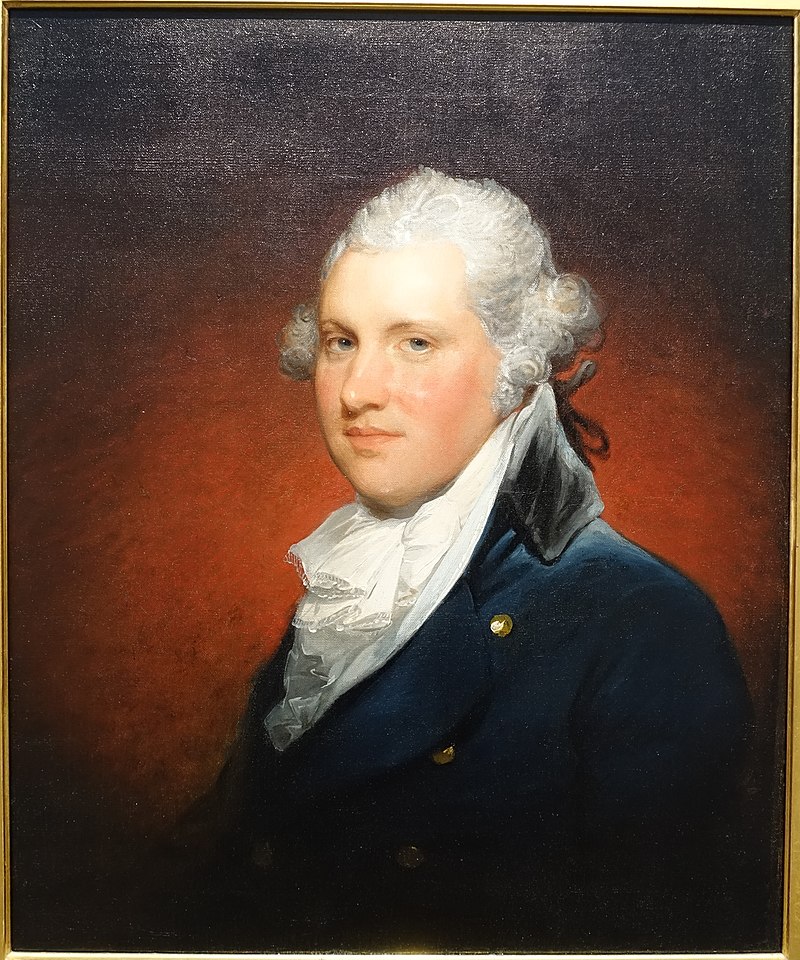
Greenleaf by Gilbert Stuart when the speculator was 30 years old. A wig, ruffles, sneer and a million dollars made him a commanding figure, briefly.
Greenleaf hired James Simmons in November 1793, before Lovering landed in America. By hiring him he sent a message to Philadelphia's elite. Simmons was the son-in-law of the city's foremost carriage-maker and had set up shop as a carriage-maker himself. He was also the younger brother of the Treasury Department head clerk well known to speculators who secured their deals with bonds issued by the Treasury.(5) Morris and Nicholson didn't join Greenleaf until after Simmons inked his contract. Word spread through town that Greenleaf aimed to build “a new elegant style of building.” Simmons was not exactly to be an architect but a supervisor of the architects Greenleaf would soon hire.(6)
In April 1794, Simmons and his “people” arrived in the city. The former senator who saw them in May did not allude to how many people were in a “people,” but there were enough men on the scene to begin building several wooden buildings to house workers and supplies on what everyone began calling Greenleaf's Point. They also began building the three story brick house at what was then 6th and N Streets SW that still stands.(7)

This photo of the-so-called Honeymoon house is from Allen Clark's Greenleaf and Law in the Federal City published in 1901
Architectural historians credit Lovering for designing what is now called the Thomas Law, or “Honeymoon,” house at 481 N Streets SW, but work started on it before Greenleaf hired Lovering in Philadelphia on May 8. After it was built it was known as "Simmon's house." (It became the Honeymoon house when Morris and Nicholson let Law and his bride, Eliza Custis, have it during the summer of 1796.)
Historians credit Lovering for designing every house built in the 1790s on or near Greenleaf's Point that is still standing. Four on 4th Street SW between O and N now called Wheat Row were in a group called "Clark's houses." Two were in a group called "Lovering's houses." They are now called the Duncanson-Cranch (or Barney Neighborhood) House on N Street SW between 4th and 6th Streets. There is no evidence suggesting Clark didn't design "Clark's houses," so why not merely credit Lovering for designing "Lovering's houses?"
This photo from Greenleaf and Law in the Federal City shows the Cranch half of the very inaptly named Duncanson-Cranch house (in 1798 the former publicly horsewhipped the latter). The house then was in a rawer condition and not handsomely restored as it is today.
Lovering did not move to the city until July, almost a month after Joseph Clark, another builder hired by Greenleaf on May 16, moved to the city. They were to build 10 and 12 houses respectively. Greenleaf probably hired Clark to build more because he was an established architect and builder. Clark had emigrated from England about ten years before Lovering. He settled in Annapolis whose large bricks houses hosted a season brilliant enough to attract the country's elite like John Tayloe of Virginia.
Clark made a name for himself. In 1790, endorsed by influential friends, he had angled for the job of planning the new capital. He went to Mount Vernon to promote his plans for a city with about "two thirds of the number of Houses that are in the City of London." Meanwhile, he had designed and was building a new dome for the Maryland State House.(8) That Washington in the end asked L'Enfant to plan the city was no reflection on his respect for Clark. In September 1793, as a leading Freemason in Maryland, he was asked to give the principal speech at cornerstone laying ceremonies for the new Capitol.
That Greenleaf made with Lovering virtually the same contract he made with Clark also attests to Lovering's credentials. He just lacked workers. He tapped some of Simmons' people and the news of Greenleaf's deal attracted other workers to the city. The federal Commissioners were impressed with Lovering and Clark. When they had to call a board to arbitrate their dispute with an elderly master mason they wanted to fire, they picked them(9).
Just a Simmons did, Lovering and Clark built three story brick houses. That made it clear that Greenleaf had not set out merely to satisfy the contract with the Commissioners which only required two story brick houses. Lovering's and Clark's fee would be 8% of the cost of the houses, so the bigger the better, but it's likely Lovering was puzzled about the location of the cluster of houses he and Clark would build. They were to be over a mile from the Capitol and almost three miles from the President's house, by water. In 1794 people who tried to get from 16th and Pennsylvania NW to 6th and N SW by land often got lost. (Don't you get lost. Today there is no more 6th Street and the Thomas Law house is on 481 N Street SW.)
Since he had met President Washington, the location did not puzzle Clark. Lovering needed a crash course to explain the President's expectation that the capital city was destined to be a world emporium with its hub on Greenleaf's Point. Once locks around the falls of the Potomac were finished in 1796, Washington was confident that the river would become the highway for world commerce. He made sure that the L'Enfant plan divided the city with a canal from the President's house to the Capitol and than when the canal turned south that it divided into two branches with one emptying into the Potomac, where Washington bought 6 building lots, and the other into the Eastern Branch, now called the Anacostia. So by owning southwest Washington, Greenleaf would control a good share of world's commerce. Don't laugh, a Belgian agent for Dutch bankers investigated the canal and the capital site in 1791 and didn't dismiss its commercial potential out of hand. Notley Young had built a wharf on the Potomac shore just off 6th Street SW that pointed due West. But then again that agent didn't advise investing yet.(10)
In 1794 Greenleaf decided to make Dutch bankers invest. Their loans had helped him become a millionaire. When living in Holland, he bought up depreciated American paper money that Congress eventually funded at face value. He reasoned that American land had to seem more valuable to European investors than depreciated paper money. Plus, so that the bank's investment wouldn't depend solely on Washington lots, Greenleaf would use its loans to finance his and Morris's and Nicholson's project to buy, develop and market 6 million acres of Western land, which in that day meant what we now call Appalachia (another not exactly brilliant idea.)
As Greenleaf's agent in Holland opened negotiations for the loan, Lovering and Clark came to a sleepy land of old fields and woods where talk about world commerce seemed out of place. But despite the prospect of having to rough it, Lovering, who had a wife (his second) and a young daughter, must have thought meeting Greenleaf a great stroke of luck. Clark certainly did. His wife Isabella would later describe how, "In June 1794 we Sold our House, our Store of Merchandize, Three Female Slaves, also about one half of our Household Furniture, not to pay our Debts, for we owed none of consequence, NO, but to carry the money to Greenleafs Point."(11)
Because there was no traffic in the largely empty city, the builders erected their temporary, wood-frame family homes right in the middle of whatever street they were building in. So the Clarks lived not on 4th Street SW where he built eight houses but in it, and the Loverings resided in the middle of N Street SW where he built seven houses. When they finished building on those streets, they planned to pick up their houses and move them to their next building site. This was not such a chaotic arrangement, since tenants and slaves of Notley Young still lived in wooden huts and raised crops off paths that criss-crossed the grid of newly surveyed squares.(12)
Commerce soon enlivened the rural scene, a shipload of lumber and lime came from New England and a newly invented brick machine came down from New York City. The latter attracted such a crowd Simmons had a fence built around it. Both builders shared in that largess as did Lewis Deblois, a builder Nicholson hired to build on lots that he had bought a year before he met Greenleaf that were east of the Capitol.(13) When cold weather in fall 1794 ended the building season, Lovering had built three double houses with one pair ready for habitation, and a single house that was thought might be expanded into a hotel. Clark had finished the interior work of a group of four houses and the shells of another group of four.

A black and white version of a Skinner Auctioneer's image of a painting attributed to George Beck showing southwest Washington. It's only virtue is that everything looks to the West which while inaccurate makes the right sales pitch. Otherwise, the houses were three story but they were not on a curving country lane with trees just so.
Along with Lovering and Clark, Greenleaf also hired a supporting staff led by brothers-in-law to oversee the architects and Simmons. When he sailed from Holland to Philadelphia in 1793, Greenleaf was joined by a Frenchman who wanted to help him spend his money. Viola, by the summer of 1794 there were three Frenchmen working in Washington, a surveyor, an accountant and what we call today a management consultant. In the winter of 1794 Greenleaf was preparing to return to Holland to collect his money. So his men in Washington made building plans for the spring of 1795. They jelled quickly. Lovering, who had had a late start, would finish his seven houses and build three more on P Street; Clark would finish his eight houses, build four more on O Street and start six on Square 166, which was close to the President's house.(14) Simmons would prepare the ground for six houses on South Capitol Street where it crossed N Street. With a bridge over St. James Creek, soon to be a canal, N Street led to the best place to build wharves on the Eastern Branch where goods would be off loaded onto canal boats in the yet to be built canal or into yet to be built warehouses.

Detail of a map by Stephen Kuter made for my book Through a Fiery Trial: Building Washington 1790-1800 (1991) showing houses clustered at the Point in 1797; "o" for brick house and "x' for wooden, based on information in Greenleaf's Papers but involving much guess work.
Then Greenleaf began getting bad news from Holland. The French army was invading, and Dutch bankers had a devil of a time figuring out how Washington lots that were scarcely selling at all could have any value. Greenleaf didn't panic. He canceled his voyage and proved that he was quite a salesmen. In November 1794, he sold 455 lots for $133,333 to Thomas Law, an Indian nabob whose family was well connected in Britain. ("Nabob" referred to men who made their fortune working in India for the British East India Company.)(15)

In his letter to his parents William Cranch never wavered in his admiration of his brother-in-law James Greenleaf. In this November 1794 letter he was in total awe.
In their contract with the Commissioners, the speculators agreed that those who bought lots from them would have a building requirement of a brick house on every third lot. So workers on the ground in Washington looked forward to a busy spring building houses. Greenleaf and Law walked together around the Point pointing where they would build. Law fell in love with New Jersey Avenue SE which ran from a good place for a wharf on the Eastern Branch up to the Capitol. They were not exactly cheered on their walk around. A group of Clark's workers clamored that they had not been paid.
As prospects of money from Holland diminished, Greenleaf decided he had to tighten the belt on his Washington operations. The stream of money to Lovering and Clark stopped until there was an accounting of what had been spent. The French accountant was not nice about it. Clark submitted a statement showing that the speculators owed him $33,000. According to Isabella Clark “a french Mutilated Aristocrat, a french Poltroon, Miscreant Ruffian,” began a reign of terror and insisted that Clark owed Greenleaf $30,000. In her stinging letter to all three speculators she blamed Greenleaf's "Myrmydons ...for murdering my Husbands Intellect by Minutia."(16)

Greenleaf and Law in the Federal City's circa 1901 photo of Wheat Row. Given the suffering Joseph Clark and his wife went through, it should be called Weep Row
The problems seems to have been that in the sunshine of Greenleaf largess, all accounts in the city were blended. Lovering, Clark, and Deblois, who worked only for Nicholson, had all shared the building materials Greenleaf ordered from New England.(17) If we can believe Isabella Clark, her husband's personal enemies made sure he took the fall. Lovering seems to have had no role in attacking Clark, but he too suffered from Greenleaf's sudden stinginess.
When the newly invented brick-making machine Greenleaf bought did not make enough bricks, the builders got some, on credit, from Daniel Carroll of Duddington, the city’s principal land owner. Original proprietors of the land had no building requirement, so they made money selling building materials to speculators who did. The contractors thought Greenleaf, having promised an unlimited supply of bricks, should pay the $1,500 bill. He didn't. Carroll was not amused. He wrote to Greenleaf: "I wish you to consider that my bricks are in your houses...." Then he sued the builders.(18)
In June 1795, despite the sale of 455 lots of Law, and large sales to another nabob, William Mayne Duncanson, and James Barry, a merchant fresh from Bombay, Greenleaf walked away from the whole project. He blamed two newly appointed Commissioners, Gustavus Scott and Thornton, for not giving Law title to the lots he bought. They wanted Pennsylvania Avenue NW developed before New Jersey Avenue SE. The Commissioners pointed out that despite the money Greenleaf got from the nabobs, he stopped paying the required installments of money to the Commissioners.(19)
Morris and Nicholson gladly took over the Washington property which they fancied had not prospered because they had let Greenleaf run the show. As Financier, Morris ran the finances of the country during the Revolution. As Comptroller, Nicholson ran the finances of Pennsylvania, until after surviving an impeachment trial, he resigned in early 1794. In parting, Greenleaf made a point of keeping all the money he made off Law, Duncanson and Barry.
Lovering dropped his work and went to Philadelphia where he charmed Morris who hired him for $1500 a year to continue building and supervise all other builders. Nicholson seconded the motion though he continued to rely on his man Deblois. Then he got his copy of Isabella Clark's letter which accused Deblois of commandeering lumber and lime and extorting the other builders. Nicholson dropped Deblois and used another Englishman, William Prentiss, as his builder, but told him to let Lovering supervise all his architectural work. (Nicholson was a wheeler dealer who often had more goods than cash. He supplied both Deblois and Prentiss with products, “wet goods” especially, that they could retail in stores for their workers and others in the nascent city that had few stores.) The partners fired Clark and directed him to give “lumber, building materials, tools and other articles of our property” to Lovering.(20)

Robert Morris trying to look stern. He was the most congenial Founder and there should be many more books about him but the complexities of the financial deals made by the old Monopolist defy the modern imagination
Lovering landed on his feet but it was on shaky ground. Morris also hired Greenleaf's brother-in-law William Cranch who was then overseeing operations at Greenleaf's Point. He was also the nephew of Morris's old friend Vice President John Adams. In a letter to Cranch, Morris discussed the money due to Lovering from Greenleaf: As for "Mr. Lovering's debts and the balance due to him [just over $3000]... you should gain as much time as you can...." Neither Lovering nor anyone else Greenleaf hired ever received any more money under the contracts they made with Greenleaf. Morris promptly sent $50 to Cranch to give to Lovering. That done, Morris told Cranch that "it seems almost time for the City of Washington to support itself."(21) Only their salaries should be sent down from Philadelphia. House rents and lot sales should raise the money to carry on the work. That didn't work out. Only the wooden houses could be rented. Most of the brick houses were not quite habitable. The less opulent future prompted Simmons to leave. He sold his elegant furniture at his house, and "two milch cows," as a last hurrah.(22)
Throughout the winter of 1795-96, Morris sent Cranch a total of $1,000 to dispense to Lovering as needed to finish the houses. Nicholson sent an additional $300, but the check bounced. Lovering managed to finish at least one house to put on the market. On June 13, 1796, Cranch placed an ad in the newspaper for a four-story brick house with coach house and stables: “the house is just finished, and has two convenient kitchens, two parlors and six lodging chambers – a brick pavement in front, and the yard and area are paved with brick.” Morris also had Lovering scout for roofing slate that he needed for his unfinished mansion in Philadelphia. So presumably Lovering was busy.(23)
Architectural historians have him even busier crediting him for designing and building another house that still stands, the William Mayne Duncanson house called The Maples, now at 630 South Carolina Avenue SE. It was built between the fall of 1795 and the summer of 1796. However, no documents or letters even allude to Lovering’s having designed or built it. There were other architects in the city. James Berry built a wharf and "a large double brick building" at the east end of N Street SE along the Eastern Branch.(24) If still standing, it would doubtless be attributed to Lovering. However, in his account book for 1795, Barry entered an October payment of $400 to James Hoban. That was the typical architect’s fee for drawings and estimating costs. Hoban was the architect and builder of the President's house.(25)
Although he was poorly funded, Lovering did not give up on the speculators. He went to Philadelphia in the spring of 1796 to spur them on. If by September 26, 1796, the speculators did not built twenty houses on lots that Greenleaf in 1793 had contracted to buy from Carroll, Carroll would repossess the lots and the speculators would owe him a penalty. Lovering did not care for Carroll, who had sued him because "my bricks are in your houses."
Morris's first inclination was to negotiate a new agreement with Carroll. Lovering was skeptical and warned that Carroll had "a most rigid disposition and will be glad to take any advantage." Lovering wanted to build those houses. Cranch approached Carroll, who proving Lovering correct, refused to negotiate. Vowing that “Mr. Carroll shall not have the forfeiture,” Morris raised $22,000, Nicholson raised $21,000, and building began in late June. Lovering designed the houses with only this advice from Morris: They "must be easy and cheap to execute and at the same time agreeable to purchasers and tenants."(26)
 From Morris's letterbook, the upper letter is to Cranch whom Morris used to give money to Lovering
The shells of twenty, two-story brick houses, some with large openings for store windows, were built in three months on the square northwest of the intersection of South Capitol and N Streets SW. The unprecedented achievement rather excited the community; a barbecue for 200 helped fuel the excitement. Plans were made to temporarily rent the houses to carpenters and plasterers in return for their finishing the interiors. Morris and Nicholson both came to the city eager to build more and save their investment. Initially even Carroll was satisfied.(27) (That he soon changed his mind led to lawsuits over who owned the Twenty Buildings not settled until 1814 by the U.S. Supreme Court, with Chief Justice Marshall writing the opinion against Carroll. The legal system in that day was a wonder. In March 30, 1798, Lovering crowed in a letter to Nicholson that he finally freed himself from the “clutches” of Carroll. Then in August he wrote that Carroll was about to win another court judgment against him.)(28)
Perhaps because none of the twenty houses survived, architectural historians look askance at the whole endeavor and give Lovering no credit as their designer.(29) While drawings for the houses have not been found, letters among Morris, Nicholson, Cranch, Lovering and William Prentiss, all mention Lovering's designs. He even had to change the designs after Carroll insisted all the houses be on one square. So Lovering turned five brick houses into ten.(30) He did make one mistake: to pay for building materials he wrote checks on the speculators' accounts after they assured that they would be covered. They weren't. Carpenters and plasterers would work to pay the rent, but they wouldn't buy what they needed to do that work. In early 1797 all three speculators assigned their property to seven trustees, a ploy to avoid debtor' prison. That didn't protect Lovering and the inevitable suits for payment that followed.(31)
Lovering's achievement won him valuable contacts. James Hoban measured the work done to determine what was owed to the carpenters and masons. Subsequently, Hoban used Lovering to measure the work done on the public buildings. This meant that Lovering gained some familiarity with oval and elliptical rooms that were central features in the President's house and Capitol. He also met one of the seven trustees, serving as the trustee's guide as he inspected all the speculators' property. Lovering also met the trustees’ agent on the scene. William Hammond Dorsey was a Georgetown merchant who would also handle financial arrangements for Tayloe during construction of the Octagon, where an oval room would help solve the problem of fitting a house into a lot that was not rectangular.(32)
As for what he made for designing and building the Twenty Buildings, judging from what he wrote in a morose New Year's Day 1797 letter, it amounted to very little. With bankruptcy staring him in the face, Morris lost interest in the Washington property. Nicholson was only 40 years old and had a wife and seven children. He couldn't give up so Lovering wrote to him. Lovering proposed "a final settlement,” taking it to arbitration if necessary. He told Nicholson, "I conceive myself of so little use or consequence that must hardly be worth your notice... It will be impossible for me to continue in this City with such perturbations of mind and embarrassed circumstances." Nicholson was still in the city wary that creditors wouldn't let him leave and appreciated Lovering's circumspection. Nicholson rated any man who did not sue him a friend. He promptly gave him $45.

Then, on January 16, Lovering's ill wife died, as announced in the local newspaper. Nicholson loaned his carriage for the ride to Rock Creek cemetery. They became friends and shared their ideas about the city. Lovering proposed building 166 three-story houses with dormer windows, which would rent or sell for 25% more than two-story houses. That dream bound Lovering to Nicholson for another two years as they both waited for Nicholson to land money from Europe to continue their building. (33)
Nicholson asked Lovering to estimate the value of all the building done with the speculators' money. Lovering put the value of the brick houses at $100,839 and the wooden houses and shops at $11,821. Before leaving Washington, Nicholson drew up an agreement with William Prentiss to build more houses and, much to Prentiss's chagrin, put him under Lovering’s supervision. That meant Nicholson would send money via Lovering. But since Nicholson sent little money, Prentiss strained to finish the five double houses he’d contracted to build.(34)
Lovering meanwhile sought out new opportunities. In October 1797 he published a notice in Washington, Georgetown and Alexandria newspapers advertising his skills as “Architect, Surveyor and Builder and c." Knowing that securing other clients might even further disincline Nicholson to pay him, Lovering didn't mention the work he got, which probably included a houses in nearby Maryland and Alexandria.(35)
Nor did he tell Nicholson when he hit the big time, a chance to design a public building. In November, the Commissioners asked Lovering to estimate how much it would cost to build George Hadfield's design for an executive office building. The young architect had come to America from England, with the highest recommendations, and was hired to superintend construction of the Capitol. He characterized his own design for the office building as “slightly ornamented” on the outside with interiors “in the plainest style.” He thought the building he designed would cost $40,000 to build. Lovering's estimate was $48,300.(36)
In his November 26, 1797, letter to the Commissioners, Lovering offered to conduct a more “minute” examination of Hadfield's design, implying he could redesign and build it more cheaply. The Commissioners had at this point been without money for two months and couldn't pay their workers. They were therefore delighted when Lovering delivered a design that would cost $42,000 to build. They planned to build at least two and possibly four executive office buildings to house the departments of the Treasury, State, War and Navy so saving $6300 on each was significant.

"Building contractor William Lovering’s 1798 drawing shows revisions
to George Hadfield’s design for the Treasury Office and served as the
contract document.
Massachusetts Historical Society." From link in paragraph below
Hadfield was not pleased. He vowed to acquaint the Commissioners with the rights of architects and demanded of President John Adams not only that his design be used but that he be hired to build it. Lovering also asked to be hired to build his design. Instead, the Commissioners satisfied neither of them, putting Lovering's design out to bid. Lovering’s bid was the third lowest. (Three years later, the winning bidder would tell the Commissioners he’d underestimated the building’s height by 7 ½ feet and would need more money.)(37)
Though he was shut out of constructing it, with Lovering’s involvement in this major public project, we might say he broke into the big leagues. One architectural historian rues that thanks to the Commissioners, and Thornton was one of them, and Lovering, instead of ''Hadfield’s sophisticated, up-to-date neoclassical building," the city got "a traditional, rather old-fashioned Georgian one." But in 1798, with inflation running rampant, Lovering’s knack for designing an economical building on a large scale must have attracted favorable attention. (The building housed the Treasury Department until President Andrew Jackson had its present home built along 15th Street NW.)
Meanwhile in January 1798, creditors had Lovering arrested for nonpayment of debts. The judge denied bail because Lovering owned no property. The sheriff posted bail for him, however, which allowed him to dun Lovering for petty cash on demand. The creditors had timed the arrest to the Maryland assembly’s annual adjournment, preventing his applying for protection under the new bankruptcy law until the legislature reassembled in December. Lovering worried that, if arrested again, he might have to abandon his five-year-old daughter and a son from his first marriage who had just joined him in Washington. He began to plan a return to England. A friend of Nicholson's in the city warned the speculator of the possible loss of “a man of abilities."(38)

Genealogists have Lovering abandoning his daughter and going to England after his wife died but a letter written over a year later reports that a son from his first marriage joined him in Washington, and, according to another letter, his daughter was still with him.
Lovering faced two dilemmas: How to make money without losing it all to Nicholson's and his creditors, and how to acquire land without capital to pay for it. He decided to do what he did best, and in lieu of money, take most of his future pay in property. The Commissioners had paid Lovering $300 for his estimate and redesign of the Treasury building. On July 10, 1798, Lovering asked them to apply it as down payment on lot 12 in Square 691, on the southwest corner of the intersection of New Jersey Avenue and C Streets SE. He asked that future payments for his design be used to cover two more annual payments on it. He wanted that square because he knew that Thomas Law was going to build on the lot across the street, indeed according to the Commissioners' records he was Law's agent when the Commissioners' surveyor laid out Law's lot.(39)
Architectural historians suggest that on that lot on Square 689, Lovering built a house that Thornton designed for Law. It had a curving front and oval rooms just as the Octagon design did. Both solved the problem of maximizing space on a lot constricted by an angled intersection.(40) In fact, neither Law's papers nor Thornton's reveal who may have designed or built what is now known as Law's third house. (It was demolished to make way for a House of Representatives Office Building.)
Unfortunately for Lovering, the Commissioners refused to pay for his executive office design. Fortunately for us, his letter back to them complaining about their treatment provides clues to the design of Law’s house. Lovering wrote: “I devoted Chearfully my time and Attention to the Office and have saved you at least 10,000 [for two office buildings] in particularizing the Building design and tho it would be natural for you Gentlemen unacquainted with the trouble of architectural details to under estimate my Services...”
Over the years in the give and take with superintending architects and builders at the Capitol, Commissioner Thornton had confessed that he was incapable of rendering his designs into drawings that builder's could use. So in one sense by accusing all the gentlemen commissioners of being “unacquainted with the trouble of architectural details,” Lovering was being kind to Thornton. However, would he dare make that insinuation if he had just laid out a lot for a Law's building which would accommodate Thornton's design which had the most complex interior of any house yet built in the city?
Lovering’s letter also suggests he did more for Law than just lay out his lot. The Commissioners suggested that to avoid the cost of future installments, Lovering should surrender his interest in the lot he had contracted for in Square 691. Lovering shot back, “I should not be Justified in relinquishing a purchase which is become advantageous by Mr. Law's Building on the opposite lot and to improve which I have made some sacrifices in Contracting with Mr. Law." At the same time he wrote to Nicholson that he had “some prospect of doing business the next Spring."(41) That prospect was probably Law's house.
Lovering likely knew in July, when he had asked for the lot in Square 691, that Law was preparing to build on Square 689. He likely knew because he himself was working on the innovative and intricate design of Law’s house. As for Lovering's self-referenced “sacrifices,” since he was awaiting the Maryland legislature’s return in order to take advantage of the state bankruptcy law, and had advertised those intentions in the newspaper, he had postponed accepting payments that might only have gone to his creditors.(42) Presumably, that means Lovering had asked Law to defer payment for his design.
Maryland’s bankruptcy laws were, for Lovering at least, an ordeal. He had advertised his intentions, as the law required, but that only excited his creditors, who then leaned on the sheriff to arrest him. On December 4, Lovering bemoaned to Nicholson that “the advertisement of my intentions has been a great injury to me for I should have had several buildings...."
In December, Lovering went to
Annapolis and secured the pledges of several legislators to support
his bill for bankruptcy protection. Some other legislators questioned
whether he was a citizen, a requisite for getting protection.
Just before adjourning in January, the legislature passed a bill
granting him protection, provided he could prove his citizenship.
When he appeared before the Chancellor for a final decision,
creditors complained about the inadequacy of his bookkeeping, and his
case was put off until February.(43)
Lovering viewed the snag as a mere
formality. On January 22, 1799, he appealed to Nicholson and Morris
on their honor not to use his bankruptcy petition as a pretext for
withholding what they owed him. Lovering understood they were short
of cash so he asked for Tennessee lands as compensation. He would get
the land surveyed, and then to go to London, where, he predicted, he
could easily sell it. Evidently, as soon as the ordeal of getting
relieved of his debts was over, he wanted to leave Washington.


Lovering's January 22, 1799, letter to Nicholson on "Honor."
Meanwhile, George Washington was
corresponding with John Tayloe about jackasses. On January 23, 1799,
Washington wrote that if Tayloe used “ready money” to buy the
animals he had expressed interest in during his last visit to Mount
Vernon, that “would be very convenient to me, as my buildings in
the City call for it....” Washington was trying to convert some of
his many assets (but not his slaves) into cash to pay for deliveries
of building materials for the two houses he was building side-by-side
near the Capitol that would do for boarding congressmen. From the Mt. Airy mansion, near Richmond, that his father had built,
Tayloe explained, in a letter of February 10, that he wouldn't buy
the jackasses because “I am anxious to appropriate every shilling I
can raise – towards the improvements I contemplate putting up in F.
[Federal] City.”
Even Virginia’s richest man was
feeling pinched for cash. So not surprisingly, he or his agent looked
up Lovering, the Washington architect noted for economical designs
and ability to finish buildings on time -- even when given just three
months to do it. For this, Lovering evidently gave up his plan to go
to London. But there was a snag.
On March 9, Lovering wrote Nicholson,
“I shall not be able to get any business at this place owing to
being insolvent. I could have had a Building to do upon a contract
close to fifteen thousand dollars for a Gentleman in [or “of”]
Virginia but could get no security therefore have lost it and I hope
and trust you will do something for me.”

George Blagden, who had just signed a contract to build George Washington's Capitol Hill houses for $11,000, had to put up $4,000 as security, which he would have been obliged to pay Washington if he didn't fulfill the contract. Poor Lovering, by his own calculations, Nicholson owed him $4,000.(44)

George Blagden, who had just signed a contract to build George Washington's Capitol Hill houses for $11,000, had to put up $4,000 as security, which he would have been obliged to pay Washington if he didn't fulfill the contract. Poor Lovering, by his own calculations, Nicholson owed him $4,000.(44)
George Washington's contract with
Blagden was for two three story houses. So the contract Lovering lost
could only have been for Tayloe's house which, other than Thomas
Law's house, was the only grand house built in or around the city in
the coming year. More interesting than Lovering's being unable to get
security is that Tayloe evidently didn't have a set design for the
house. Lovering was the local expert in coming up with cost estimates
for designs, down to the last dollar, but in this case the building
was “close to fifteeen thousand dollars.” The contract Tayloe
finally made in April was for $13,000, which implies that in March he
had not settled on what he wanted in the house, or what he could do
without. (According to Dorsey's account book by 1802 the project would
eventually cost $28,476.82.)(45)
So sometime in late February or early
March, Lovering first became involved with the Octagon. As far as
documentary evidence goes, Thornton's first mention of the project is
in his April 19, 1799, letter to George Washington in which he wrote
simply that Tayloe made a contract to build the house.
It is possible that, any time after
Tayloe bought his lot in April 1797, Thornton could have given him a
plan for a house to fit it. That's what the author of Building the
Octagon thinks. Orlando Ridout V suggests that Tayloe first
received a plan for a house from Benjamin Latrobe, who in 1796 was
making a career designing buildings in Virginia. Latrobe’s papers
contain undated plans for a house for Tayloe on a right-angle corner
lot. Ridout thinks that when Tayloe bought the angled corner lot in
1797, he lost interest in Latrobe, who was very busy anyway and had
not yet visited Washington. So, Ridout reasons, Tayloe worked with
Thornton who had the advantage of being in the city.(46)
But no evidence supports Ridout's
timeline. Latrobe's plans are undated. Tayloe and Latrobe would
become business associates in a Washington steamship company Latrobe
formed in 1813.(47)
Maybe Latrobe's plans were for the post-War of 1812 building
boom that inspired mansions much like the one Latrobe drew for
Tayloe. It also makes little sense that, upon buying a corner lot on
an angled avenue that presented a greater challenge to an architect,
Tayloe would have stopped dealing with a professional architect and
sought a design from Dr. Thornton, a self-professed amateur
architect.
Ridout quotes Mrs.
Thornton's 1800 diary to show how Tayloe might have solicited a
design from Thornton in 1797, 1798 or early 1799, years when Mrs.
Thornton didn't keep a diary. In early 1800, after Thornton discussed
houses with Daniel Carroll, one of that gentleman's slaves knocked on
his door with a note asking Thornton to design a house suitable for
Capitol Hill boarders. In two days, the design was done.(48)
Carroll's brother built the house and sold it as soon as it
was built. Ridout speculates that Thornton did the same for Tayloe
between 1797 and 1799, only in this case he designed not an
anonymous, quickie boarding house but an architectural treasure. (In Did Thornton Really Design the Octagon house, I discuss Carroll's motivation for asking Thornton for a design.)
In his book Ridout describes a better
documented episode showing how a person building a major house found
the right architect. In
1801, Belgian emigre Henri Joseph Stier broke off negotiations with
Latrobe for a country mansion in nearby Maryland. Latrobe struck him
as “one of those who do not finish their work."(49)
He sought out Lovering instead. In his April 9, 1800, letter to
Greenleaf lauding his new house, Thomas Law mentioned that “Steer”
was staying in one of his other houses. Perhaps Law told Stier about
Lovering who had designed and built his new house.(50)
Lovering came, Stier wrote to his son,
“expressly to show me three different plans, rather ingenious but
complicated, and with unattractive facades.... He has proposed to
direct my construction with such a plan as I will give him, to attend
to the progress and the designs in detail, to come twice each week,
and that if I want to hire enough workmen to finish it in twelve
months, he will do it for $600....” Ridout uses that
quote in Building the Octagon but cuts the words “ingenious”
and “complicated."(51)
Ridout casts Lovering as a mere builder incapable of designing
anything as ingenious and complicated as the Octagon. Cutting those
words saves Ridout from having to speculate that Lovering did the
Octagon design for Tayloe.
In her introduction to a collection of
Stier's daughter's letters, Margaret Callcott writes that Lovering
“was eager to make himself agreeable to the wealthy Belgian, and
all during March he met regularly with the Stiers and gave them tours
around completed houses around Washington.” They signed a contract
on March 24, 1801, a month after first discussing the project. Yet
architectural historians give Lovering little credit for the design
of what was built, concluding that Stier based the design on his
house in Belgium.(52)
Stier's adventure in house building
does not exactly parallel Tayloe's. The young Virginian bought the
lot he built on two years before he broke ground. So he had time to
think and rethink what he might build there. Unlike Stier, he also
was interested in the investment potential of Washington lots. The
first gossip about his interest in the city popped up in late 1796,
when rumor had Tayloe building on Square 688, near the Capitol.(53)
In the end, he didn't buy lots there. (Latrobe's design was for the
southeast corner of a square; if that was Square 688, it would have
afforded an unappealing view of the intersection of B and First
Streets SE, rather than of the Capitol.)
By the fall of 1798, Tayloe had bought lots elsewhere in the city.(54) So yes, he had two years to think about the lot where he eventually built the Octagon but he bought lots elsewhere in the city. So we can't assume that his purchase of an angled lot in April 1797 started a two year process of deciding what to build there. Indeed there is evidence that he didn't decide to build there until 1799.
By the fall of 1798, Tayloe had bought lots elsewhere in the city.(54) So yes, he had two years to think about the lot where he eventually built the Octagon but he bought lots elsewhere in the city. So we can't assume that his purchase of an angled lot in April 1797 started a two year process of deciding what to build there. Indeed there is evidence that he didn't decide to build there until 1799.
Tayloe's letter to Washington about not
buying the asses contained just one sentence about the Federal City.
The rest of it was devoted mainly to seeking Washington’s advice on
a momentous career decision. Should he accept the appointment,
arranged for him by Washington, as an officer in the army Washington
was raising at President Adams’s request to respond to the threat
of French aggression? Or should he run for Congress as a Federalist
to stop Jefferson and his pro-French Republican party from gaining
power? The newly formed American navy was already at war with France.
Washington recognized the importance of
the question and responded two days later without a word about asses
or houses. Since opposition to good government was at that moment a
greater threat than the French, Washington strongly encouraged the
political career. Tayloe already represented his district in
the Virginia state senate, so he thought he could easily be elected to
represent it in congress. So he needed to start building a house in
Washington. If Washington had wanted him as an officer and member of
his personal staff, while Tayloe went where war might take him, his
family could continue to live in Mt. Airy or with his wife's family
in Annapolis.
So Tayloe had two months to find a
builder before the traditional start of the building season. He did
not live in the city. He needed an established architect and builder.
But how would Tayloe have known about Lovering? Unlike Thornton,
Lovering was not a man with whom Tayloe would have socialized. But
Tayloe's agent in the city, William Hammond Dorsey, did know
Lovering. In early December 1798, they conferred about the business
of the trustees who trying to extract money from Nicholson.(55)
Dorsey was also Georgetown’s senator in the Maryland legislature;
Lovering mentioned to Nicholson that several legislators were helping
him get bankruptcy protection, possibly including Dorsey.


Lovering's December 4, 1798, letter to Nicholson:
conferring with Dorsey to help out the man who owed Lovering $4,000
conferring with Dorsey to help out the man who owed Lovering $4,000
Since Tayloe didn't live in the city in
1799, it was likely Dorsey who gave Lovering the bad news that Tayloe
required monetary security. Worse news was to come. On April 10, the
new sheriff notified Lovering that his creditors had writs that would force the sheriff
to seize all of Lovering's property the following day, along with a
notice in the newspaper in effect warning people not to do business
with Lovering. Because court was in session at the county seat in
Upper Marlborough, there were no lawyers in town to help Lovering on
short notice. Someone, my guess is Dorsey, who was a merchant not a
lawyer, advised him to hurry to Annapolis and see the Chancellor.
Lovering lacked money for the trip. He
sought it from Thomas Law, for whom, he said, he had made “some
sacrifices.” Law gave him what he needed. In Annapolis, Lovering
saw the Chancellor, who quashed the sheriff's writs. This is such a
fairy tale ending to Lovering's crisis that one has to suspect the
fine hand of a superior power. Indeed, in November, the legislature
had elected Benjamin Ogle governor. He was Tayloe's father-in-law.
Lovering had the joy of writing to Nicholson about the reaction of
their creditors when Lovering gave them the Chancellor's order: “You
would have been pleased to see their chagrin."(56)
With the building season about to
begin, Thornton wrote to Washington on April 19, “Mr. J. Tayloe of
Virga has contracted to build a house in the city near the
President's square of $13,000 value.”
As Tayloe had just spent the night of April 17 at Mount Vernon,
Washington probably already knew all about it. Had Thornton been the
Octagon’s designer, then, you might expect a shout out from the
former president, yet in his April 21 reply to Thornton's letter,
Washington wrote only of his own houses, not Tayloe's.
Unfortunately, Thornton's letter to
Washington didn't include the builder's name. Judging from a letter he
wrote to Nicholson on April 22, Lovering had not worked out the
problem with security yet. While he eventually was superintending
architect building the Octagon for a fee of $900, he didn't sign the
contract Thornton mentioned. In his letter, Lovering began with his usual update on
how Nicholson's creditors had reacted to offers of settlement relayed
to them by Lovering.
Then he addressed his own problems: “I have nothing to do here and shall be soon be on my way to Philadelphia, as I now am down to the last shilling without any hope of getting any relief, I am extremely sorry you should be driven to extremity you mention and could I serve you in any thing I should be happy.”
Then he addressed his own problems: “I have nothing to do here and shall be soon be on my way to Philadelphia, as I now am down to the last shilling without any hope of getting any relief, I am extremely sorry you should be driven to extremity you mention and could I serve you in any thing I should be happy.”
Even though he was begging for money,
that is a startling juxtaposition of sentiments: his own sense of
worthlessness and his continued devotion to the man who was much the
cause of it. Then his letters to Nicholson stopped.


"...down to the last shilling, without any hopes of getting any relief..."
Lovering April 22, 1799, letter to Nicholson
On April 25 Thomas Law wrote to
Washington that “your corner stone is to be laid today and I am to
attend” and that same day Law was signing a building contract.
Law's April letter to Washington was undated, but marked received
April 5. However, the modern editors of Washington's papers cite internal evidence for dating the letter as sent on April 25, in which case Lovering could have signed the
contract to build Law’s third house just three days after his
morose letter to Nicholson. That Law would suddenly spring the
contract on Lovering, renewing negotiations begun the prior fall, is
well within the spectrum of Law's excitable character. However, Law's
contract has not been found but since Lovering wrote of having made
“sacrifices in contracting” with Law back in his October letter
to the Commissioners, why not give him the benefit of the doubt and
credit him working on both the Octagon and Law's third house? He life
certainly turned around. In December 1799 he married his third wife.
That Lovering became the superintending
architect at the Octagon despite all his financial woes doesn't prove
that he designed it. Yet why, even after the embarrassment of
Lovering's being unable to post security, did Tayloe continue to
want him as the house's superintending architect? That is to say, why after not hiring
Lovering in March did he still wind up hiring him as the man telling
the foremen of the workers how to translate plans, the like of which
they had probably never seen before, into a reality? The likely
answer is that Tayloe needed Lovering because he decided to use
Lovering's design for his house. Lovering's lack of security was not
an insurmountable obstacle. Someone else could put up the money. For
example, James Hoban joined Blagden in putting up security for
Washington's houses.
That said, a year later Lovering
offered designs to Stier but told him that if Stier didn't like them,
he would build what he wanted. Stier hired him and he and Lovering
evidently bickered through the building process.(57) However, Tayloe was
not on the scene. He divided his time between Mt. Airy and Annapolis.
He had to trust Dorsey who handled the money and Lovering who handled
the workers. He could not bicker over design details.
There is no clinching argument to prove Lovering designed the Octagon. If he had gone on to design similar houses in the city, that would have come close. But a newspaper ad he ran on May 1, 1800, suggests familiarity with Octagon and similar projects:
William
Lovering, Architect and General Builder – Begs leave to inform his
friends and the public, that he has removed from the City of
Washington to Gay Street, the next street above the Union Tavern in
Georgetown, where he plans to estimate all manner of building, either
with materials and labor, or labor only. Specimens of buildings
suitable for the obtuse or acute angles of the streets of the City of
Washington, may be seen at his home.(58)
Ridout suggests
that the ad shows Lovering's attempt “to capitalize on his
experience with the unorthodox plan of the Octagon.” More likely,
he was attempting to capitalize on designs he had made for Law and
Tayloe.
Lovering remained in the city at least through 1802. He supervised the construction of a temporary meeting hall for the House of Representatives. Once the Federal government settled in the city, the boom in residential building in the city fizzled. President Jefferson summoned Latrobe to the city to continue work on the public buildings, but Latrobe did not use Lovering's services. Lovering eventually moved to Philadelphia where in 1809 he advertised lessons in architecture and carpentry. He likely died soon after.
If Thornton did design the Octagon and Law's third house, it certainly didn't inspire him to become a working architect. He offered designs to friends and one, Tudor Place in Georgetown, is as treasured as the Octagon. However, as long as the Capitol grew year by year, his contemporaries never lost sight of Thornton's role in its design. President Washington appointed him as one of the federal Commissioners charged with getting the Capitol built. Architectural historians point to his well documented service as a Commissioner beginning in October 1794 as the perfect prologue to his designing the Octagon.
In the third part of this essay, I'll show that his work as a Commissioner diminished his reputation as an architect especially at the time when his friends George Washington, Thomas Law and John Tayloe needed one.
Go to Part Three: Would you have asked William Thornton to design your house?
Lovering remained in the city at least through 1802. He supervised the construction of a temporary meeting hall for the House of Representatives. Once the Federal government settled in the city, the boom in residential building in the city fizzled. President Jefferson summoned Latrobe to the city to continue work on the public buildings, but Latrobe did not use Lovering's services. Lovering eventually moved to Philadelphia where in 1809 he advertised lessons in architecture and carpentry. He likely died soon after.
If Thornton did design the Octagon and Law's third house, it certainly didn't inspire him to become a working architect. He offered designs to friends and one, Tudor Place in Georgetown, is as treasured as the Octagon. However, as long as the Capitol grew year by year, his contemporaries never lost sight of Thornton's role in its design. President Washington appointed him as one of the federal Commissioners charged with getting the Capitol built. Architectural historians point to his well documented service as a Commissioner beginning in October 1794 as the perfect prologue to his designing the Octagon.
In the third part of this essay, I'll show that his work as a Commissioner diminished his reputation as an architect especially at the time when his friends George Washington, Thomas Law and John Tayloe needed one.
Bob Arnebeck
(Mandy Katz was a great help with editorial comments and copy-editing.)
Go to Part Three: Would you have asked William Thornton to design your house?
1. Orlando
Ridout V, Building the Octagon pp. 76, 82, 155-6. James Hoban also
measured the work with Lovering but represented the contractors.
2. Lovering
to Commissioners, October 4, 1798, Letters to Commissioners, RG 42,
National Archives (microfilm)
3. Lovering
to Commissioners, January 8, 1798.
6.Greenleaf's
letterbook in the Historical Society of Pennsylvania has copies of
contracts he made; Simmons' genealogy; Blodget to Commissioners,
Dec. 5, 1793.
7,. Dalton
to Greenleaf, May 20, 1794 HSP; Letters from Appleton to Greenleaf in
the HSP describes the early activity at the Point.
8. http://marylandstatehouse.blogspot.com/2014/07/joseph-clarks-dome.html
9. Commissioners to Lovering, Clark and Henderson,
9. Commissioners to Lovering, Clark and Henderson,
10. Cazenovia to Willinks, June 16, 1791 Holland Land Company papers.
11. Isabella
Clark to Greenleaf, Morris and Nicholson, November 28, 1795, Nicholson microfilm. For a copy and ms of letter see https://capitalslaves.blogspot.com/2018/07/did-isabella-clark-see-slave-brickmakers.html
12. Appleton
to Cranch February 2, 1795 HSP;
Lovering to Nicholson, December 7, 1796.
13. Deblois
to Nicholson, April 14, 1794; to see two 1795 letters from Deblois to Nicholson see https://dcswamp.blogspot.com/2019/09/two-letters-from-deblois-to-nicholson.html
14. Appleton
to Henry, February 3 & 9, 1795
15. Greenleaf and Law in the Federal City, p. 106.
16. op.
cit.
17. Deblois to Nicholson, December 11, 1795.
17. Deblois to Nicholson, December 11, 1795.
18. Greenleaf
to Carroll, June 8, 1795, Carroll Papers, LC; Carroll to Greenleaf
June 9, 1795, HSP. Morris to Cranch, March 6, 1796, the bill was for
the nice round sum of 500 Maryland Pounds.
19. Greenleaf and Law in FC pp. 153ff.
19. Greenleaf and Law in FC pp. 153ff.
20. Nicholson
to Clark, August 18, 1795, Nicholson letterbook HSP.
21. Morris to Cranch, August 17, 1795
21. Morris to Cranch, August 17, 1795
22. Greenleaf
and Law in FC, p.51; Simmons' ad July 3, 1795.
23. Morris to to Lovering Sept 12, 1795, to Nicholson, April 29, 1796, to Cranch October 1, 1795, February 16, May 22, 1796; Washington Gazette, June 22, 1796.
23. Morris to to Lovering Sept 12, 1795, to Nicholson, April 29, 1796, to Cranch October 1, 1795, February 16, May 22, 1796; Washington Gazette, June 22, 1796.
24. Greenleaf
and Law, p. 257.
25. Barry
Papers Hist. Soc. Of Washington; Barry
to Commissioners, April 19, 1796
26. Law
to Commissioners, February 2, 1797; Lovering
to Nicholson, June 27, 1796; Morris
to Cranch April 12 and May 30, 1796
27. Greenleaf and Law in F.C., p. 129
27. Greenleaf and Law in F.C., p. 129
28. Washington
Gazette June 25, 1796; Barry to Law, August 4, 1796; Law to
LaGarrene, August 22, 1796: Carroll
to Morris, May 14, 1797; Lovering to
Nicholson, March 30, and August 27, 1798. Carroll last attempt to
jail Lovering was over $24 unpaid for bricks for which Lovering was
security.
29. Creating Capitol Hill, pp. 79-82, ignores Lovering's role in designing the houses. Bryan in A History of the National Capital gives Lovering credit, p.278.
30. Lovering to Nicholson,[five houses into ten]
30. Lovering to Nicholson,[five houses into ten]
31. Prentiss
to Nicholson, {check bounce],
32. Lovering
to Nicholson Dec. 19, 1796; E.g.,
Hoban to Commissioners, September 20, 1798; Lovering
to Nicholson, March 27, 1797
33. Nicholson to Morris, Dec.1796 and Jan. 1797. Nicholson diary, LC(?)
33. Nicholson to Morris, Dec.1796 and Jan. 1797. Nicholson diary, LC(?)
34. Lovering
to Nicholson [houses]; Prentiss
to Nicholson, April 17, 1797; Lovering to Nicholson, May 19, 1797
35. Ad
dated October 7, 1797; Rideout, Building the Octagon,
p. 29 ; W. H. Bryan has Lovering
moving to Alexandria in 1797 for which there is no other evidence so
he probably moved their temporarily while building a house.
36. Lovering
to Commissioners, November 26, 1797.
37. Lovering to commissioners, June 21, 1798; Commissioners Proceedings June 20, 1798
38. Ibid. January 14, 1798; Samuel Ward to Nicholson, August 31, 1798.
37. Lovering to commissioners, June 21, 1798; Commissioners Proceedings June 20, 1798
38. Ibid. January 14, 1798; Samuel Ward to Nicholson, August 31, 1798.
39. Bryan,
A History of the National Capital, p. 311.
Bryan adds that, "If Mr. Lovering was the principal in this
enterprise and not merely the architect, he did not carry it out, as
a house was built in the latter part of 1799 by Thomas Law who
occupied it as his residence in the following year." Bryan was
aware of Glenn Brown's rediscovery of Thornton as an architectural
genius. Bryan credits Thornton for designing the Octagon. But
evidently no one then knew of any reason to credit Thornton for
designing Law's house.
40. Creating Capitol Hill, pp. 128-9.
40. Creating Capitol Hill, pp. 128-9.
41. Lovering
to Commissioners, October 4, 1798; Lovering
to Nicholson, October 10, 1798.
42. Commissioners
to Lovering, September 22, 1798
43. Lovering to Nicholson, December 4, 1798 and December 27, 1798
43. Lovering to Nicholson, December 4, 1798 and December 27, 1798
45. Ridout, p. 153.
46. Ridout,
pp. 37-49
47. Delfino, Southern Society and Its Transformations, p. 206.
48. Ridout p. 29.
48. Ridout p. 29.
49. Margaret
Callcott, editor, Mistress of Riverdale, p 28.
50. Law to Greenleaf, April 9, 1800, Adams Papers.
50. Law to Greenleaf, April 9, 1800, Adams Papers.
51. Ridout,
pp. 28 and 76.
52. Ibid. p. 29; https://npgallery.nps.gov/AssetDetail/NRIS/73002166
53. Law to Commissioners, Feb. 6, 1797.
52. Ibid. p. 29; https://npgallery.nps.gov/AssetDetail/NRIS/73002166
53. Law to Commissioners, Feb. 6, 1797.
55. Lovering
to Nicholson, December 4, 1798.
56. Lovering to Nicholson, April 17, 1799
56. Lovering to Nicholson, April 17, 1799
57. Callcott, p. 29.
58. Quoted
in Ridout, p. 123


